




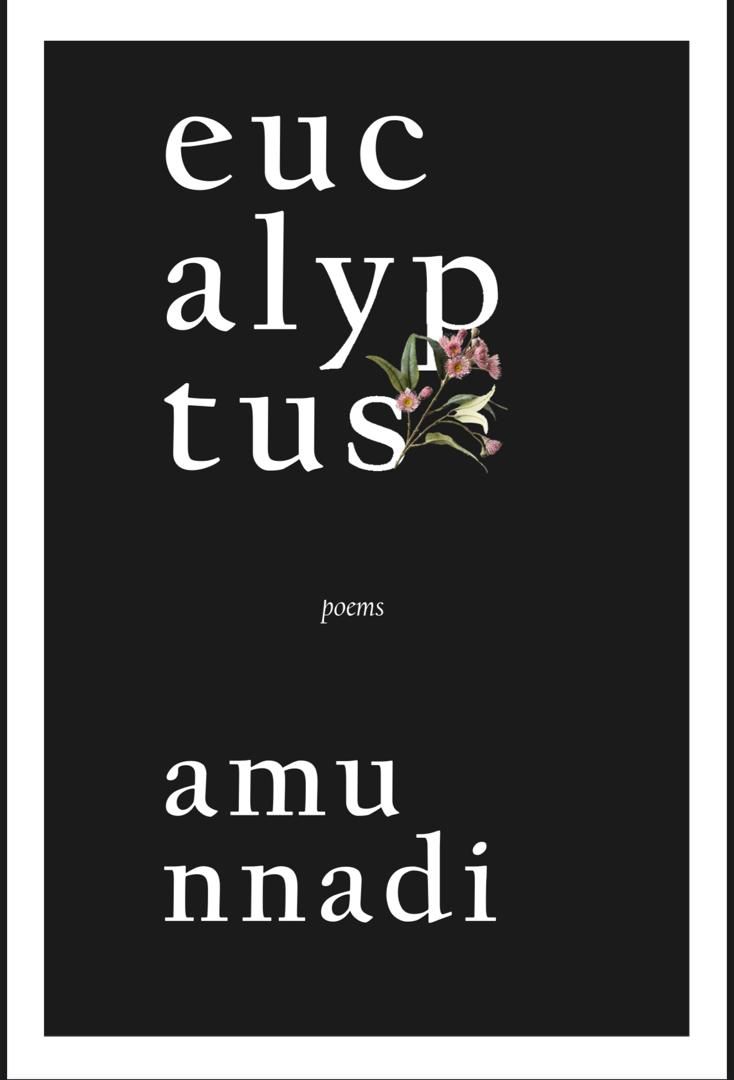
Book review: Examining Ogadagidi and Abai-Ola in Amu-Nnadi’s Eucalyptus, by Fortune A. Austin
Of Ancestral Footprints and a Poet’s Awakening:
Ogadagidi is a poem that does not merely describe power, it performs it. It arrives with the gravity of ritual and sustains itself through invocation, repetition and sonic authority. From the first utterance, the work establishes itself as ceremonial speech, a chant designed, not for passive consumption, but for communal awakening. One does not simply read Ogadagidi, one is drawn into its mystic circle and grandeur.
The poem’s greatest strength lies in its command of mythic scale. It speaks comfortably in the register of the elemental: wind, thunder, fire, cloud, yet never loses its rootedness in land, lineage and named places. This oscillation between the cosmic and the ancestral gives the poem its gravitas.
It declares:
“you are ogadagidi! a lion’s majestic roar
ofo in the potent paws of a proud pride
edem ani offers to nsukka asadu a name
for its grit, strength of its arms, the avid
tenor of its roar! the land offers its voice
and thunder will not withstand its fury…”
Power here is not abstract, it is territorial, inherited and affirmed through return. The repeated motif of homecoming is especially striking, suggesting that true conquest is not displacement but renewal.
Linguistically, the poem is luxuriant and assured. Its diction is deliberately expansive, even imperial, befitting the figure it invokes. Images unfold with ceremonial patience, accumulating rather than rushing, allowing meaning to deepen through recurrence. The strategic repetition of chants does not exhaust the poem. Instead, it fortifies it, mirroring the cyclical logic of ritual and tradition, both oral and lived.
What is most compelling is the poem’s philosophical posture. Ogadagidi resists the modern impulse to individual heroism and, instead, locates greatness within continuity: child to man, man to ancestor, ancestor among the living. Identity here is not self-fashioned but communally forged.
“for a child has become a man, ogadagidi!
ogadagidi! man too becomes an ancestor
for the ancestors abide amongst all men!”
The poem insists that becoming is collective, that history breathes within the present and that the land itself is an archive of divine footprints.
Ultimately, Ogadagidi reads as an act of cultural affirmation. It is a deliberate and artistic reclaiming of indigenous cosmology, sound and epistemology, within the written form. The poem stands at the intersection of orature and literature, reminding us that the written word can still carry drumbeat, incantation and ancestral voice.
Somewhere it also declares:
“you stand at the intersections of what is
known, and what is not known, what is
carved by winds, to keep as a monument
a heritage held as hills of oshushua edem
upraised oji of a land and it’s incarnation
a carnival to declare a people’s becoming…”
Ogadagidi is a work of formidable ritual consciousness; of mythic ambition. It asserts its origins without apology and speaks from a place of deep cultural knowing. The poem does not seek validation, it commands recognition. Long after the final chant fades, one is left with the impression, and understanding, that a presence has been named, a lineage affirmed, and a people re-centred within their own power and prospects.
“i call nsukka in the chant, i draw the lion
to its full height, to the roars of its power
adada prowls the diewa of our dreams, we
who name her, the inheritors of prescient
hills and of lejja’s iron bones arise
the possessors of a past, and it’s prospects”
Abai-Ola:
“for who can stand when arrows fly
from the far banks; who can divine
the cries of the crows which huddle
in what dialect can sorrow be told
when the heart owns all languages…”
The poem “abai-ola”, written in honour of Igisi Orubo, is an inheritance of imagination and language. It carries the mark of the kind of writing that feels as though it existed before you touched the page; something both ancient and prescient. There is a depth that is difficult to imitate, a voice that sounds ancestral, ceremonial and impossibly seasoned. It has the weight of something that could only have been written once.
What makes it extraordinary is not just the imagery, but the command of magnitude. It moves effortlessly between the intimate and the cosmic, treating memory and mortality with a reverence reserved for sacred texts. The metaphors, sunset holding its own grief, fruit falling only to rise again, the sun refusing to pause in its orbit, carry the precision of something divinely whispered, rather than crafted by human hands.
The language works like an incantation. Each line unfolds with a slow, deliberate grace, echoing like footsteps in a vast ancestral hall. There is a pulse, steady, unbreakable, that makes this poem feel alive even in its stillness, and Igisi Orubo alive even in death. The repetition of “days that will not end” becomes more than a refrain; it becomes a philosophy, a worldview, a declaration that memory surpasses death.
There is also something almost ceremonial about the way Otuabagi is invoked, not as a place, but as a guardian of legacy. it avers: “for the days of the man cannot end/with an immense ocean of memory/and here, in otuabagi, we keep like/horizons all the moments with you/each light, each sorrow/each totem…” The poem transforms location into lineage, and lineage into eternity. Igisi Orubo does not merely appear in the poem; he expands within it, becoming a symbol of continuity that transcends the page.
If any critique exists, it lies only in the poem’s rarefied brilliance; it does not seek accessibility, it seeks immortality. It speaks in a language that demands the reader rise to meet it. And having met it, to fly with it as though words become wings, and wings become eternal, a scribal flight into the infinite rendering of both word and utterance.
Indeed,if I am permitted to declare, this is the kind of writing that feels unrepeatable.It has that rare, almost mythical quality where every line seems to echo beyond itself, where the poem becomes a vessel of memory, culture, and spiritual weight. It is not simply well-written, it is crafted from a place most writers never reach.