

Celebrating Dan Agbese, by Valentine Obienyem
The first time I heard of Newswatch magazine was in 1986. I was then in SS1. One of our auxiliary teachers who handled Literature-in-English, Mr. Job Okonkwo, walked quietly into the classroom that day. He looked pale—unusually subdued. Without a word, he wrote NEWSWATCH on the board and asked how many of us knew the magazine. I can no longer recall our response, but what followed left an indelible impression on many of us.
He told us that Mr. Dele Giwa, the Editor-in-Chief of Newswatch, had just been murdered by a parcel bomb. That tragic announcement was how many of us first became aware of the magazine – not through its journalism, but through the terrible price paid for truth. We learned that day that journalism could be dangerous.
Mr. Okonkwo went on to tell us more about Newswatch: how it was founded by Dele Giwa, Dan Agbese, Ray Ekpu, and Yakubu Mohammed, and how the quartet introduced fresh ideas that would revolutionise journalism in Nigeria.

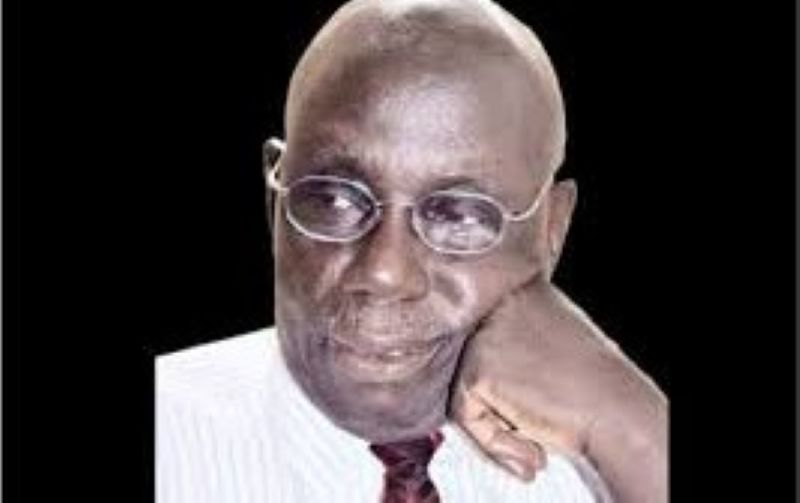
A few weeks ago, one of the magazine’s co-founders, Chief Dan Agbese, passed on. Mr. Peter Obi marked his death with a tweet, recalling his brief encounters with him and highlighting his trademark frankness and objectivity – qualities evident even in his analysis of the 2023 presidential election.
Today, we were scheduled to travel from Lagos to Abuja. As preparations were underway, Mr. Obi called to say the trip had been cancelled. There was, he explained, a memorial event in Ikeja which he would ordinarily have attended himself, but for unforeseen developments. The event was scheduled to begin at 1:30 pm.
“Where are you?” he asked.
“Somewhere around Banana Island,” I replied.
“Leave whatever you are doing,” he said, “and go to the venue. I will send the invitation and other details to you on WhatsApp. Represent me.”
He went on to say:
“Val, Dan Agbese was a good, objective journalist. I admired him because he was deeply concerned about leadership and the direction of the country. He was, unarguably, a patriot.”
As Mr. Obi spoke, a clear picture of the journalist Dan Agbese emerged. He was not a catch-and-carry journalist. He was not a praise-singer. He belonged to a tradition in which journalism served the public interest, not personal or political vanity.
I was privileged to read Agbese’s articles in 2023, when Obi’s entry into the presidential race unsettled the political establishment. Agbese recognised the significance of that candidacy – not as a personality cult, but as a disruption of a failing political order and an awakening of civic consciousness, particularly among young Nigerians. His commentary was marked by intellectual honesty and independence – qualities Mr. Obi consistently admired.
At the event held at the Whitestone Event Place, Billings Way, Oregun, Ikeja, tributes flowed freely and sincerely. In a country where even the devil can procure a hagiographer and be granted posthumous sanctity, Agbese did not have to procure anyone. Those who worked with and for him testified to who he truly was. Taken together, the tributes were a testament to his journalistic genius.
One fact stood out unmistakably: Dan Agbese was a journalist’s journalist. He mentored many, shaped careers, and raised professional standards. My friend, Dotun Oladipo, summed it up aptly: Agbese’s outlook was always to make one a better person and a better journalist.
I also listened to the tribute by Maureen Chigbo, publisher of Realnews magazine – one of the scions of Newswatch academy as they boldly call it. She echoed the same verdict. She recalled meeting Agbese for the first time in Ghana. A man with a keen eye for talent, he invited her to work with Newswatch. “He made promises and kept them,” she said. “He encouraged people. Some principles you learn from him early remain useful throughout life.”
As the tributes continued, my thoughts drifted naturally to Mr. Godwin Agbroko. Godwin Agbroko, the late Chairman of ThisDay’s Editorial Board, was assassinated in 2006. Between 2003 and his death, he published my opinion pieces almost weekly – as though I were a staff columnist. One day, I visited ThisDay to see Rev. Okey Ifionu, and asked to be shown Agbroko’s office. When I entered and introduced myself, he sprang from his seat and threatened to stifle me with a warm embrace.
I thanked him for the honour of consistently publishing my work. He replied that ThisDay was the one being honoured by providing a platform through which readers could benefit from my “highly educative pieces.” I expressed surprise that he had used those articles without any formal acknowledgment or even a phone call from me. He smiled and said, “Val, it is only someone who does not understand quality who would not publish your articles.”
The climax of the memorial was the closing reflection by Ray Ekpu, the oracle himself. He traced the history of Newswatch: the shared dream, the principle of equal remuneration, and the democratic culture in which major decisions were subjected to voting. He spoke of how they consciously transcended Nigeria’s fault lines of ethnicity and religion, dismantled the culture of editorial omnipotence, and took collective decisions – from cover story to back page.
Ekpu noted that although Dan Agbese was the oldest among them and of blue blood, that he never played royalty and never displayed a superiority complex. “Dan was not just an editor,” he said. “He was a mentor.” He rejected the dictatorship of words and firmly believed that every act – including journalism – has a moral obligation to be understood or shut up.
Regretting what journalism has gradually turned into – especially the brand beholden to “Afghanistanism,” where attention is fixated on distant or safe issues while urgent local truths are ignored – he recalled a very different era of practice. In their time, the measure of journalistic glory was not popularity or proximity to power, but courage: the readiness to go in and out of detention, to endure proscription, harassment, and intimidation in defence of the public interest. That tradition, he noted with some sadness, stands in sharp contrast to what is often obtainable today,
There is much to learn from that generation. One enduring lesson is the beauty of collaboration – how four friends, Dele Giwa, Dan Agbese, Ray Ekpu, and Yakubu Mohammed, shared a vision and joined hands to build an institution that changed Nigerian journalism.
Dan Agbese belonged to a vanishing breed. Nigeria is poorer without him – but richer for having known him.
After the event, as Ray Ekpu was leaving, I took the opportunity to have a photograph with him. When I introduced myself again as representing Mr. Peter Obi, his face brightened and he said, “What of my in-law? Please give him my regards. Tell him that we are following him and that he is doing very well.”