



End game on Electoral Act amendment, by Pius Mordi
Four years ago, Prof. Mahmoud Yakubu as chairman of the Independent National Electoral Commission (INEC) assured Nigerians that the humongous N355 billion budget for the general elections out of which N117.37 billion was dedicated to the procurement of “electoral technology” will guarantee credible elections. Top of the basis for his assurance was the pledge that results of elections would be transmitted real time from every polling unit nationwide. The promise triggered an unprecedented enthusiasm from the younger generation who were enamoured by the prospect of the emergence of the winner of popular votes. They mobilised their huge segment of the population for what promised to be a pivotal poll.
Even though the election became an anticlimax in outcome, INEC never blamed it on the failure of technologies it procured to effect the real time transmission of results from the polling units. Rather, “technical glitch”, an amorphous term INEC used to justify its failure to upload results to its IREV and resort to the use of unintelligible and audaciously altered hard copies of results. It was an engineered chaos that left the election, of the most crucial one, the presidential election, in tatters and paved the way for the Supreme Court to make the final call on who emerged president.
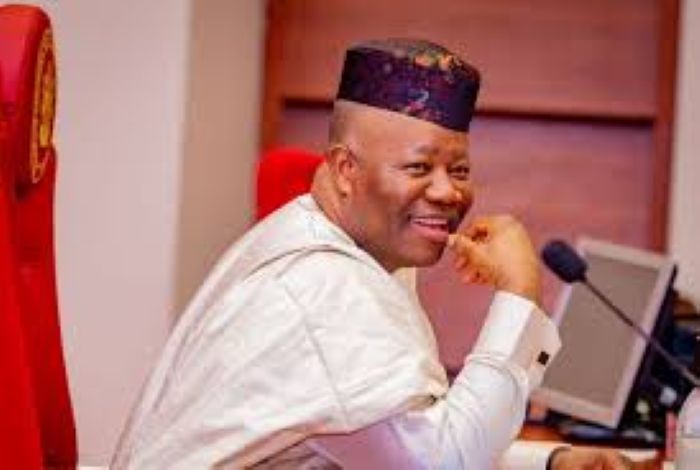
If INEC could not decisively blame real time transmission of results for the fiasco the 2023 presidential poll eventually became, Godswill Obot Akpabio, the nation’s chief lawmaker and leader of the National Assembly, took up the task. He is a lawyer, served as Commissioner in his Akwa Ibom State and was governor for eight years. He is not known to have ventured into telecommunications or information technology even as Minister of the Niger Delta. Curiously, however, Akpabio, today, is the chief advocate for dumping the use of technology in making national elections more credible. Against the stance of Nigerians and even majority of his colleagues in the Senate, he has determined that the network provided by the service providers will fail, a projected failure so considerable that he barely wants electronic transmission of election results.
Despite the outcry by opposition parties, civil society groups and former electoral officers that superintended previous elections before retiring from INEC, Akpabio has doubled down on his queer position. At his instance, the House of Representatives which had in December unanimously adopted and voted for real time transmission of election results in its version of the Bill to review the Electoral Act has been under tremendous pressure to roll back the bill. It’s not a stroll in the park for Speaker Rt. Hon. Abbas Tajudeen, unlike his counterpart in the upper chamber.
He has a vibrant and vociferous majority to contend with as the rowdy scene that erupted after he played the Akpabio card when the Senate President ruled against the obvious majority opposed to the declaration of state of emergency in Rivers State in a contentious voice vote. Tajudeen was shouted down over his undisguised desire to tow the path charted by Akpabio on Tuesday.
With the “right” men presiding over both chambers of the National Assembly, it does not need the self-styled “prophets” to discern that despite the campaigns by many groups and stakeholders, what Akpabio wanted will be adopted. The clear reason is that it is what Aso Rock favours. And what Aso Rock favours is the path Akpabio will deliver.
In 2023, the promise of real time transmission of election results drove many to the polls in the quest for change. What happens to voter turn out when the National Assembly proceeds with its executive arm-inspired insistence on manual transfer of results when there is “no network” is not difficult to imagine. The younger ones may not longer be enthusiastic to vote, reinforced by the perception that the outcome may not be the product of popular votes. Just like in the 2023 technical glitch, there will be “no network” in 2027. Elon Musk’s Starlink cannot be adopted because there will be no room for the human element in determining the election’s outcome. Invariably, a credible election is still a long way off.
Postscript
It has taken quite some time to get back on track. Since last November when my world took an unscripted turn, I have been unable to collect my thoughts and maintain my weekly column. My wife of 28 years, Mrs. Kate Onyeka Mordi, passed on upturning my world. A Chief Superintendent with the Nigeria Immigration Service, our life revolved around our shared desire: making the most of an inclement economy, shielding our children from the pains and challenges many in their generation have to contend with.
She left on November 7, 2025. Unexpectedly. Prematurely. And it was not easy. Still isn’t. But as friends and family keep saying, life has to go on. Just like the heart. Kate was my pillar of strength, my strategic planner with a never-say-die spirit. If I contemplated what needed to be done, what we had to accomplish, she always took the task of a field general, making sure no obstacle got overbearing.
She is in a better place now. And I am eternally grateful to her for our time together. The children and I.