





Powering the Pyramid: How Decentralised Energy is Redefining Nigeria’s Digital and Economic Future
By: Theresa Igata
The global energy gap remains a stark challenge. While global access has reached 92%, sub-Saharan Africa now accounts for 85% of the world’s un-electrified population.In Nigeria, despite an installed capacity of approximately 13,625 MW, the national grid continues to struggle with instability, often dispatching only 4,000 MW to 4,900 MW for a population of over 200 million, according to the World Bank’s Tracking SDG7: The Energy Progress Report (2025).
In 2026, the push for Decentralised Renewable Energy (DRE) has moved from a “niche alternative” to a “national priority.” With the national grid experiencing multiple collapses in late 2025 and early 2026, mini-grids are now the central pillar of Nigeria’s strategy to keep the lights on.
The Global Stakes and the Nigerian Reality
The World Bank’s 2025 Energy Progress Report also states that the world is currently standing at a crossroads. While developed nations are debating the nuances of “net-zero” emissions, a staggering 650 million people are still fighting for the basic right to flip a switch.
The United Nations has raised the alarm that at the current pace, the world will fall short of Sustainable Development Goal 7 (SDG7, the global promise to ensure affordable, reliable, and modern energy for all by 2030.
The burden of this energy poverty is not evenly distributed. The UN reports that nearly 9 out of every 10 people living without electricity today are in sub-Saharan Africa. This isn’t just a technical failure, it is a development trap.
Without power, there is no internet, without the internet, there is no digital inclusion, and without digital inclusion, millions of Africans are locked out of the modern global economy.
Nigeria: The Giant with a Power Problem
Nigeria sits at the heart of this crisis. Despite being Africa’s largest economy, the gap between potential and reality is vast. Data from USAID and recent World Bank briefs highlight a frustrating paradox: Nigeria has the infrastructure to generate over 12,500 MW, yet the average daily output often hovers between 4,000 MW and 5,000 MW.
For the average Nigerian, this translates to estimated billing, noisy petrol generators, and a constant struggle to stay connected.
From “Passive” to “Powerful”
The position of international bodies like the United Nations Development Programme (UNDP) is now clear: Africa cannot simply wait for the grid to grow. The future of the continent depends on Alternative Clean Energy. By investing in solar and wind, Nigeria isn’t just fixing a power problem; it is joining a global movement to decarbonise the economy, fighting climate change while simultaneously lighting up the lives of those at the bottom of the pyramid.
GVE Projects: A Case Study in Grassroots Innovation
Driven by a passion for social equity, Ifeanyi Orajako, CEO/Founder of Green Village Electricity (GVE) Projects Ltd, has positioned his company at the forefront of this energy revolution.
What started as an undergraduate dream with zero capital has evolved into a leading renewable energy powerhouse.
GVE’s impact now spans beyond its initial footprint, reaching thousands of households across states including Niger, Anambra, Rivers, Akwa Ibom, Ogun, Plateau, and Gombe. By bypassing the high costs and logistical hurdles of extending the national grid to remote areas, GVE is providing a decent form of power to those at the bottom of the economic pyramid, moving them away from the health hazards of kerosene lamps and the noise of petrol generators, Orajaka told Politicaleconomistng
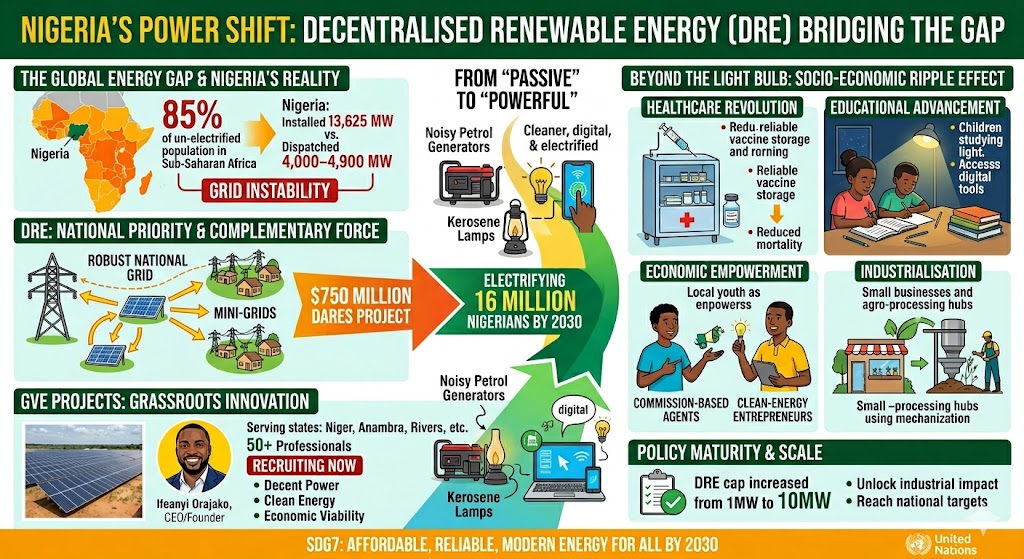
The company evolved from a lean core team of six into a robust workforce of over 50 professionals, with aggressive recruitment currently underway to meet the surging demand for off-grid solutions.
According to Orajaka, this internal scaling is a direct response to a pivotal moment in Nigeria’s energy landscape, aligning with the $750 million Distributed Access through Renewable Energy Scale-up (DARES) project, a mission to electrify over 16 million Nigerians by 2030.
A Complementary Power Paradigm
He noted that Distributed Renewable Energy (DRE) is not a replacement for the national grid. Instead, it serves as a critical complementary force in Nigeria’s quest for energy reliability. While the national grid remains a pillar of the infrastructure, DRE provides the agility and decentralization necessary to bridge the gap.
Resilience in a Shifting Market
The sector is not without its risks, but these factors have become increasingly measurable and manageable. In a market defined by the steep and steady price hikes of traditional fuel alternatives, DREs have emerged as the most commercially viable and socially attractive option for the Nigerian public.
Policy Maturity and Scalability, not all gloom
The electricity ecosystem has matured significantly, creating a fertile ground for delivery at scale. A major catalyst for this optimism is the recently announced increase in the DRE cap from 1MW to 10MW. This policy shift unlocks new levels of industrial and community impact, facilitating a much higher probability of hitting national electrification targets.
Measurable Impact vs. Conventional Systems
“Over the last decade, Nigeria’s power sector has seen more tangible progress through DREs and embedded systems than through conventional grid expansion. This trend is expected to persist until long-standing transmission inefficiencies are resolved”, Orajaka said.
Proof of Concept: “The shift is already visible at the highest levels of the economy. Nigeria’s seat of power is now fully supported by DRE, and the Dangote Refinery, the nation’s largest industrial complex operates via an embedded system rather than relying on the national utility”.
Beyond the Light Bulb: The Socio-Economic Ripple Effect
The true value of GVE’s intervention in communities like Bisanti in Niger State, is measured in “lives changed,” not just “kilowatts delivered”.
Healthcare Revolution: Access to reliable power has drastically improved vaccine storage, leading to a visible reduction in mortality rates from malaria and other preventable diseases.
Educational Advancement: Literacy levels have surged as children can study after sundown, and schools gain access to digital learning tools.
Economic Empowerment: The “commission-based agent” model has turned local youth into clean-energy entrepreneurs.
Industrialisation: Small businesses and agro-processing hubs are springing up, as electricity allows for the transition from manual labor to mechanized production, fundamentally raising the standard of living.
These trajectory confirm that the future of Nigerian energy is not just about “waiting for the grid,” but about building a diverse, resilient, and decentralised power network.
Reporting by Theresa Igata (Senior Correspondent)