


Nigeria’s Joint Investigation Centre Concludes Probe into 1,450 Terror Suspects
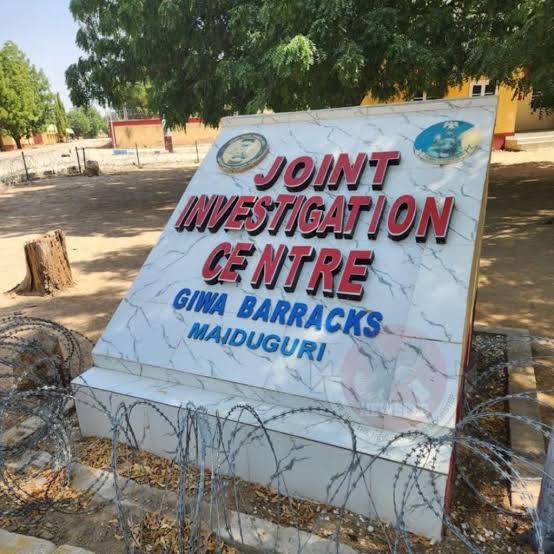 In a significant milestone for Nigeria’s counter-insurgency efforts, the Joint Investigation Centre (JIC) at Giwa Barracks, Maiduguri, has announced the completion of investigations involving 1,450 suspected terrorists.
Brig.-Gen. Yusuf Audu, the Centre’s Commander represented by Capt. Puole Obinwale disclosed during a press briefing that the facility’s rigorous screening process has already cleared over 500 suspects for prosecution, many of whom have subsequently been convicted.
A Unified, Multi-Agency Approach
The JIC serves as a centralized hub for interrogating and processing individuals detained during operations against Boko Haram and ISWAP. Its strength lies in a collaborative model that integrates expertise from several national bodies: Military and Intelligence: Nigerian Army and Defence Intelligence Agency.
Law Enforcement: Nigeria Police Force, DSS, and NSCDC.
Civilian and Legal: Nigerian Correctional Service, NIS, NDLEA, and legal experts from the Office of the Attorney-General.
Upon arrival, suspects undergo a structured evaluation where a complex casework group reviews evidence to determine the most appropriate track for each individual:
Prosecution: For those with clear evidence of criminal insurgency.
Rehabilitation: For those deemed eligible for deradicalization.
Reintegration: For those cleared of active participation in terrorism.
All investigations are conducted under the Terrorism Prevention Act, utilizing biometric data capture to maintain a national security database and ensuring judicial oversight via Federal High Court remand orders.
Welfare and Human Rights Standards
Despite the high-security nature of the facility, Brig.-Gen. Audu emphasized that the JIC adheres to global best practices regarding human rights and inmate welfare:
Cells are segregated by gender. Minors accompanying their mothers receive basic education and specialized care.
Health & Hygiene: In collaboration with the International Committee of the Red Cross (ICRC), the facility provides medical services, including tuberculosis treatment and a 40,000-litre solar-powered borehole for clean water.
Mental Well-being: Detainees have access to sports, indoor games, and a “family links” program to communicate with relatives.
Skill Acquisition and Rehabilitation
To ensure detainees remain productive and gain vocational value, the centre has introduced several skill-acquisition programs:
Vocational Training: Tailoring, cap making, and bakery operations.
Agriculture: Farming, poultry, and fish farming.
The JIC’s success is bolstered by support from global partners:
UNODC: Constructed evidence storage facilities.
IOM: Developed advanced data management systems for suspect categorisation.
UNICEF: Provided educational materials for juveniles.
By combining professional investigative techniques with robust human rights safeguards, the JIC continues to play a pivotal role in Nigeria’s strategy to balance effective counter-terrorism with the rule of law.