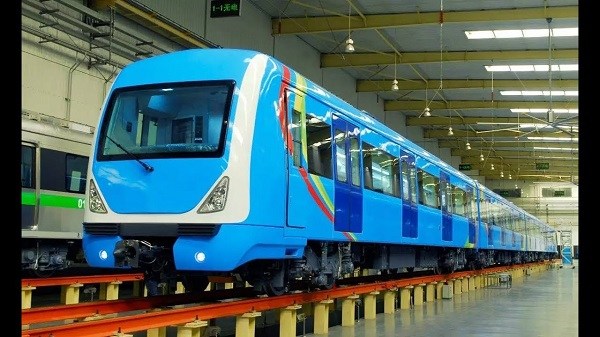
Lagos Blue Line rail

Leadership is often a relay race. And the true measure of a leader, as a matter of fact, is not merely how fast he runs his own lap, but how effectively he receives the baton, preserves momentum, and passes it on stronger than he found it.
In Lagos State, Governor Babajide Olusola Sanwo-Olu has demonstrated this principle with remarkable consistency, proving that continuity in governance can be as powerful as innovation.
As his tenure gradually winds down, it is fitting to pause and acknowledge a man who, despite enormous challenges, has stayed the course and kept Lagos moving forward. Simply put, Governor Sanwo-Olu did not drop the ball.
When he assumed office in 2019, he inherited not only the responsibility of governing Africa’s most populous city but also the burden of sustaining the developmental trajectory established by his predecessors – Bola Tinubu, Babatunde Fashola and Akinwunmi Ambode. From the visionary foundations laid by them to the infrastructural revolution and even the transformative projects, expectations were understandably high. Many, of course, wondered whether Sanwo-Olu could sustain the momentum.
Today, the answer is clear.
Under his watch, Lagos has continued its steady march toward becoming a modern megacity. His administration has recorded significant achievements across transportation, infrastructure, healthcare, education, technology, housing, security, and economic development.
Perhaps nowhere is his impact more visible than in transportation. The long-awaited rail revolution in Lagos became a reality under his leadership. The Blue Line Rail project, conceived years earlier, was brought into operation, providing a much-needed alternative to road transportation and easing the burden on commuters. The Red Line followed, further reinforcing the vision of an integrated mass transit system for the state.
Road infrastructure has also remained a major focus. Strategic roads and bridges across the state have been rehabilitated, reconstructed, or expanded, helping to improve connectivity in a city whose population continues to grow at an astonishing rate.
The health sector witnessed notable progress as well. The completion and commissioning of modern healthcare facilities, investments in primary healthcare centres, and efforts to strengthen emergency response systems have enhanced access to quality medical care for millions of residents.
His administration’s handling of the COVID-19 pandemic remains one of its defining moments. At a time of uncertainty and fear, Lagos emerged as the epicentre of Nigeria’s response. Through coordination, resilience, and strategic planning, the state navigated one of the most challenging public health crises in modern history. While no response was perfect, the leadership demonstrated during that difficult period earned widespread recognition.
Education equally benefited from sustained investment. Schools received upgrades, digital learning initiatives were expanded, and efforts to improve educational outcomes continued in line with the broader vision of building a knowledge-driven economy.
In housing and urban development, the government continued to tackle the perennial challenge of accommodation through various housing schemes while pursuing urban regeneration projects designed to improve the quality of life for residents.
Perhaps one of Governor Sanwo-Olu’s greatest strengths has been his temperament. Calm under pressure, measured in speech, and focused on execution, he has often chosen results over rhetoric. In a political environment where noise frequently competes with substance, his style has been refreshingly pragmatic.
His administration has also maintained fidelity to the THEMES+ Agenda, focusing on Traffic Management and Transportation, Health and Environment, Education and Technology, Making Lagos a 21st Century Economy, Entertainment and Tourism, and Security and Governance. This framework has provided continuity while allowing room for adaptation to emerging realities.
Of course, no administration is without criticism. Lagos remains a city battling traffic congestion, housing deficits, flooding, population pressure, and infrastructure demands that often outpace available resources. Yet the challenge of governing Lagos is unlike that of any other state in Nigeria. Every day presents new complexities, and every solution often creates demand for even bigger solutions.
Against this backdrop, Sanwo-Olu’s stewardship deserves commendation.
Equally commendable is the prospect of a seamless transition. If, as many political observers predict, Deputy Governor, Obafemi Hamzat, eventually emerges as the next governor, Lagos would once again be demonstrating the value of experience, continuity, and institutional memory. Hamzat has been an integral part of the current administration and possesses a deep understanding of the state’s developmental agenda.
The baton, it appears, may be passing into capable hands.
And as Governor Sanwo-Olu enters the final phase of his tenure, he can take pride in knowing that he helped preserve and advance a vision larger than any individual. He inherited a moving train and ensured it remained on track. He strengthened institutions, completed critical projects, initiated new ones, and maintained the confidence of many Lagosians in the promise of progressive governance.
History often judges leaders not by perfection but by impact. By that measure, Babajide Olusola Sanwo-Olu has earned his place in the evolving story of Lagos. For that, Lagosians owe him gratitude.
Thank you, Governor Babajide Sanwo-Olu, for not dropping the ball. As you prepare for life after office, may the years ahead bring fulfillment, good health, and the satisfaction that comes from service rendered with dedication. And may Lagos continue to flourish, building on the foundations laid by those before you and strengthened by your own contributions.
The journey continues, no doubt, but your chapter in the Lagos story has been written with distinction.
Azuh Arinze, FNGE, is the Publisher/Editor-in-Chief of YES INTERNATIONAL! Magazine and author of important books like The CEO’s Bible 1 and 2, Anything and Everything Journalism, Success Is Not Served A La Carte, Conversations with Showbiz Stars, My Story of Many Colours, etc