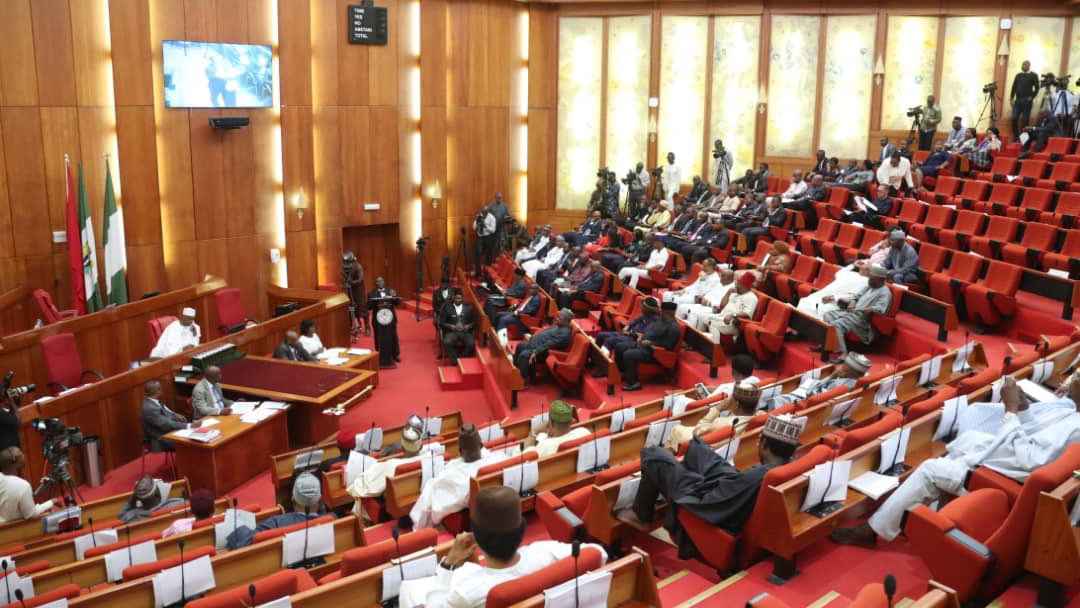
Senators in session

With rare urgency, the Senate on Wednesday passed the landmark constitutional amendment bill establishing state police in Nigeria through an accelerated process in which the Senate had to suspend its own rule.
The bill, titled “A Bill for an Act to Alter the Constitution of the Federal Republic of Nigeria, 1999 to Provide for the Establishment of State Police and Related Matters (Sixth Alteration) Bill, 2026 (SB. 1055)”, was approved during consideration by the Committee of the Whole, presided over by Senate President Godswill Akpabio.
By this act, the legislation replaces the existing Nigeria Police Force framework spelling out a dual structure comprising a Federal Police Service and State Police Services.
The bill is foundational for the creation of state policing, including the establishment of state police commissions.
It however retains the federal police structure in every state until a state police service becomes operational.
When fully operational, the Federal Police Service will be responsible for federal offences, security within the Federal Capital Territory (FCT), national security matters, interstate crimes and organised criminal activities, while state police services will be charged with local law enforcement, maintenance of public order and protection of lives and property within their respective states.
The legislation goes further to provide guidelines for the appointment, oversight, discipline and removal of both the Inspector-General of Police and state police commanders.
It does not leave state police commands with absolute powers as it empowers the Federal Government to intervene in state police operations under limited circumstances, including a breakdown of public order, operational incapacity or threats to national security.
The bill was considered after Senate Leader Opeyemi Bamidele (APC, Ekiti Central) presented its general principles. It subsequently scaled second reading, was considered clause-by-clause and passed third reading.
To pass the bill, the Senate adopted manual voting process after electronic voting devices failed to function despite repeated attempts to activate them for more than 30 minutes.