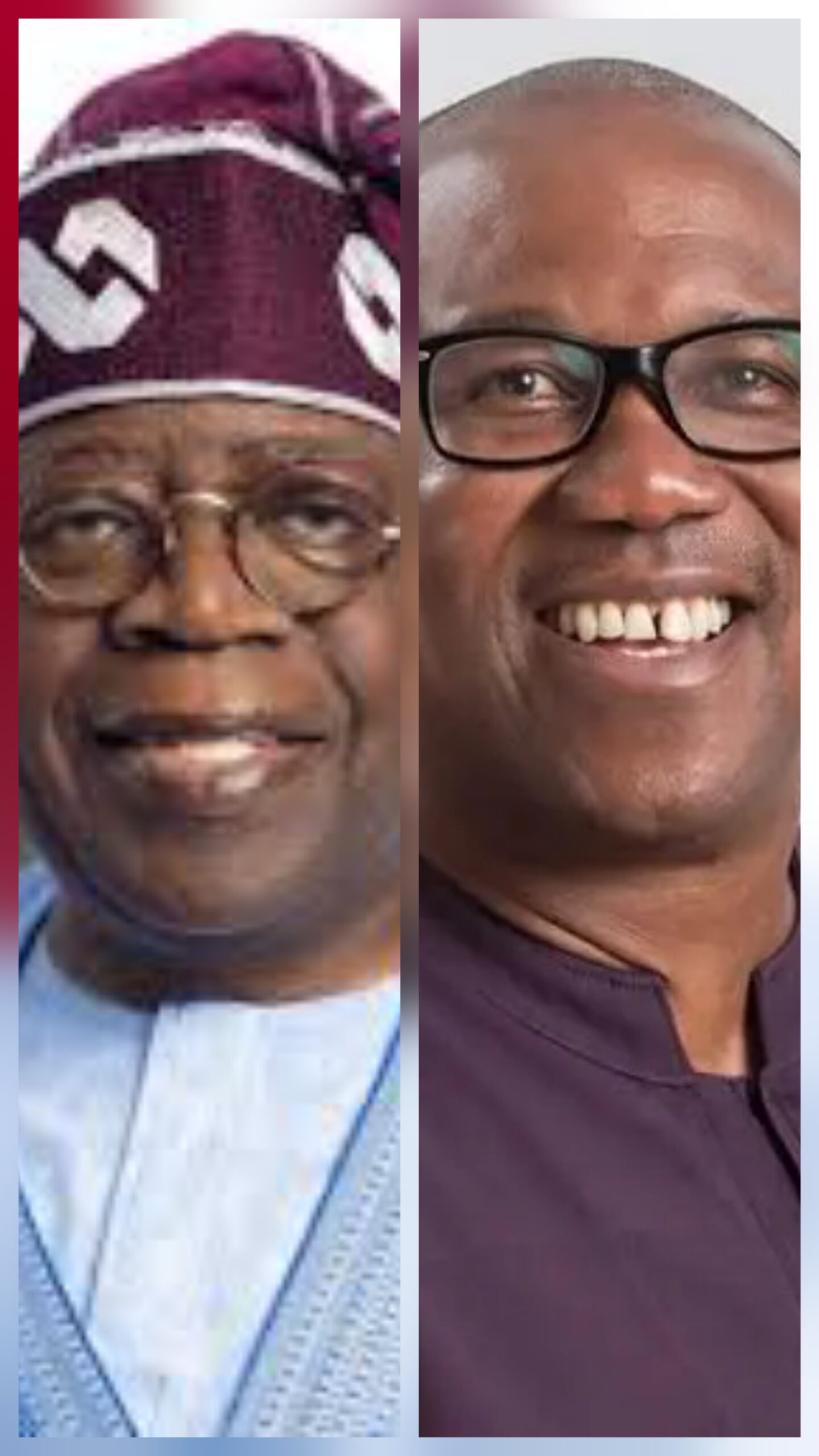
Tinubu and Obi

The innocuous call by the presidential candidate of the Nigeria Democratic Congress (NDC), Peter Obi, on President Bola Ahmed Tinubu to resign from office, having failed to improve the living conditions of Nigerians in recent years, has generated a lengthy reaction from his media aides but has failed to address the issue.
Obi’s call was based on the very obvious failure of governance, which is apparent with Nigerians living below the poverty line rising from 87 million when the President came to power to 140 million.
Rather than address the issue of leadership and accountability, the presidency embarked on shadow chasing, talking about the weekend’s charade election and the types of government, whether presidential or parliamentary. Meanwhile, they forgot that Nigeria was not running a parliamentary system when the President mobilised Nigerians to demand the resignation of the then-President Goodluck Jonathan.
Our principal’s call was for President Bola Tinubu to learn a lesson from the action of the British Prime Minister, who chose to resign after acknowledging that his government had failed to sufficiently improve the living conditions of its citizens.
Obi’s intervention was neither personal nor partisan. It was a reflection on leadership and accountability. Unfortunately, rather than engage with the substance of the argument, the presidency chose to respond with insults, distortions, and self-congratulatory rhetoric.
“We would like to state clearly that our principal’s comments were not about whether Nigeria operates a presidential or parliamentary system. They were about a fundamental principle of leadership: accepting responsibility for outcomes.
“The British Prime Minister did not resign because of the nature of the British political system. He resigned because he understood that leadership comes with responsibility and accountability.
“It is also important to correct the misleading suggestion that resignation is alien to presidential systems or is somehow anti-constitutional. Comparative democratic practice shows otherwise. In several presidential systems, leaders have resigned under different circumstances. In the United States, Richard Nixon resigned in 1974 over the Watergate scandal.
“In Brazil, Fernando Collor de Mello resigned on account of corruption allegations. In Peru, Pedro Pablo Kuczynski resigned, while in Argentina, Fernando de la Rúa stepped down during a severe economic and social crisis. These examples demonstrate that resignation is not incompatible with presidential systems but remains a recognised, though rare, feature of accountability in presidential democracies.
“Ironically, when President Tinubu himself made similar calls on President Goodluck Jonathan, Nigeria was operating the same presidential system it operates today.
“Tinubu then mobilised Nigerians and repeatedly demanded Jonathan’s resignation during the fuel subsidy protests and following the Chibok schoolgirls’ abduction.
“At that time, neither he nor his supporters argued that Nigeria’s constitutional structure prevented such demands. Leadership standards should not change depending on who occupies the office.
The Peter Obi Media Office would therefore like to reiterate that his advice to the President is based on the reality that the last three years have been among the worst in Nigeria’s history. The number of Nigerians living in poverty has risen from about 87 million to approximately 140 million. The debt burden accumulated under this administration is unprecedented, yet it has not been matched by a corresponding improvement in the lives of ordinary citizens.
No amount of political rhetoric and grandstanding can conceal the fact that millions of Nigerians are enduring unprecedented economic hardship. Businesses are shutting down. Manufacturers face unbearable production costs, while warehouses are filled with unsold goods because of weak consumer demand. Unemployment and underemployment remain widespread. These are not opposition narratives; they are the daily realities confronting ordinary Nigerians and evidence of failed governance.
The presidency boasts of GDP growth, increased revenue, and stock market gains. Yet these claims only reinforce the concern that, despite such indicators and the removal of fuel subsidies, conditions in critical areas of development have worsened. Economic growth that does not translate into improved living standards is merely statistical growth. The true measure of economic success is not the performance of the stock market but the well-being of the average citizen.
A government must ultimately be judged not by the figures it publishes but by the improvements in the lives of its citizens.
The presidency’s response to security is equally troubling. While acknowledging isolated operational successes, it ignores the painful reality that insecurity has become more widespread than ever before. What was once largely confined to certain parts of the country has now spread across virtually every region. Kidnapping, banditry, violent crime, and attacks on communities have become national concerns rather than regional challenges. Farmers are unable to cultivate their lands safely, businesses operate under constant fear, and citizens increasingly feel vulnerable regardless of where they live. Leadership requires honesty about challenges, not selective celebration of isolated victories.
The presidency also attempts to personalise the discussion by attacking Obi’s record as governor of Anambra State, which he leaves to history and objective records to judge. When Obi assumed office in Anambra State, he promised to restore civility to governance, reduce the cost of government, improve education, healthcare, and infrastructure, provide access to remote areas of the state, strengthen security, and leave savings for the future of the people. He achieved over 80% of those promises. Indeed, Anambra ranked first in the implementation of the Millennium Development Goals (MDGs) and recorded significant improvements in healthcare and education. These facts remain verifiable.
What is particularly disappointing is the attempt to portray concern for Nigeria as political grandstanding. Patriotism demands that we speak when things are going wrong. Silence in the face of suffering is not loyalty to country; it is complicity.
The presidency cites the outcome of the weekend elections as evidence of public endorsement of its performance. Nothing could be further from the truth. It is disheartening that what many Nigerians viewed as a deeply flawed electoral exercise is now being presented as proof of good governance.
If the electoral shortcomings witnessed during the weekend elections are a preview of what Nigerians should expect in future elections, then our democracy is in grave danger. Elections are supposed to strengthen public confidence in democratic institutions, not weaken it. They are meant to reflect the freely expressed will of the people, not generate widespread concern about the integrity of the process. If such elections become the new normal, then Nigerian democracy is indeed in peril.
Even more disturbing is the nation’s distorted sense of priorities. It is only in Nigeria that a country can budget approximately ₦298 billion for primary healthcare—the foundation of any meaningful healthcare system—while allocating about ₦873 billion, nearly three times that amount, for elections. Such a situation demands urgent national reflection.
Obi did not call for resignation out of malice or political calculation. He sought to draw attention to a leadership culture that must evolve if Nigeria is to make meaningful progress. Across successful nations, leaders understand that public office is a sacred trust and that accountability is not a sign of weakness but of strength.
Rather than expend energy attacking critics, the government should focus on addressing the urgent issues confronting Nigerians: unity, insecurity, unemployment, poverty, power shortages, declining productivity, and the erosion of public confidence in governance.
Nigeria deserves leadership that listens more than it lectures, serves more than it celebrates itself, and accepts responsibility rather than constantly searching for excuses.
It is time to end this deceit. The task before us remains the same: to build a united, secure, productive, and prosperous Nigeria where every citizen can live with dignity and hope. A New Nigeria is Possible.