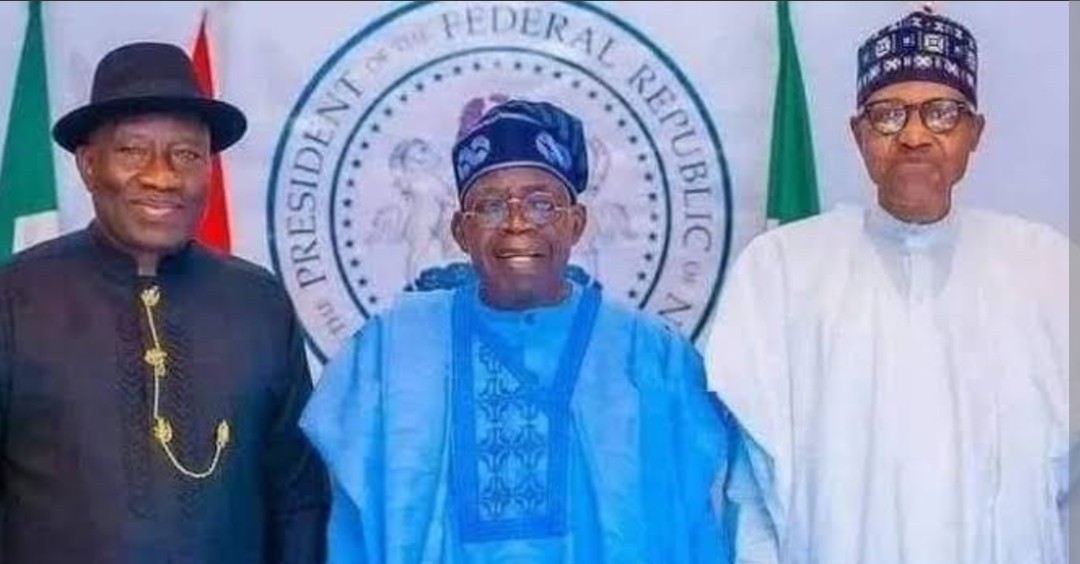
Tinubu flanked by Buhari and Jonathan
The Tinubu government should talk less and do more. It has been long in words and verbal sophistry but short in actions. The streets are red with rage.

Barely one week back, precisely on June 19, the newly built Obama Presidential Centre was opened to the public. That was after an invite-only ceremony to formally introduce the rather expensive centre to the public. Barack Obama was 44th president of the United States for two terms from January 20, 2009 to January 20, 2017. The first black man to achieve that feat. Supremely brilliant (even his fiercest critics acknowledge this); that’s Obama.
More on account of his skin colour than anything else, Obama faced a backlash from white supremacists and their apologists. But this never broke him. He kept to his 2008 electoral campaign promises, chief of which was affordable and accessible healthcare. He overhauled the American healthcare system by signing the Affordable Care Act into law in 2010. It was a huge relief for Americans especially the underclass who had struggled to meet up with fiscal demands of healthcare. The birth of ObamaCare pushed down healthcare cost and many poor families got a bailout. The impact was real, not like the rhetorical conjurations of a good salesman trying to sell an obviously bad product. He did keep yet another campaign promise. He kept America safe.
For a country that was rocked by coordinated terror attacks on September 11, 2001, it was almost not expected that Obama, a man who never served in the US Marines nor ever had any military experience, would be the one to take down and take out terror leader Osama bin Laden and his drug-addled brain followers. Obama did on May 2, 2011, 10 years after the bloody onslaught on America.
Many other leaders showed and are showing that democracy is not in platitudes but in impactful actions. Narendra Modi of India and Xi Jinping of China have through intentional leadership moved millions of their citizens out of poverty. They promised it. They achieved it. Compare these with Nigeria’s democratic leaderships. They create more dynasties of poverty; minting poorer and poorer Nigerians as if on a contest.
May 29 marked exactly three years in the life of the President Bola Tinubu APC-led Federal Government. Add to that the 8 years of Muhammadu Buhari. There, you have it: 11 years of APC dominion. It was also another democracy milestone and exactly 27 years unbroken run of constitutional government in Nigeria. I will not lament the 16 years of roguish but somehow productive leadership foisted on the nation by the PDP. It is not worth the trouble anymore.
This day, it makes much sense to focus on the APC government, 11 years after. The APC rode to power on the crest of change. The birthing of the APC government was a huge relief for Nigerians who had been denied the basic things of life by an under-performing PDP government. The frustration was so unbearable for Nigerians. The people simply wanted a change, a fresh lease. APC read the dashboard cleverly. Change was the inevitable terminus. APC offered hope to a people in despair. CHANGE was the wand.
And pronto, the people got their wish. In 2015, Bola Tinubu, Muhammadu Buhari, Bisi Akande, John Odigie-Oyegun, Atiku Abubakar among other power mandarins in the APC had their way. But 11 years in the saddle, has anything changed? Yes and No. Change has happened, both punitive change and pleasurable change. To effectively evaluate the performance of the APC government, it is apposite to contextualise this analysis within sectorial compartments.
APC promised to deal ruthlessly with insurgency in the North East which by 2014 had spread to Abuja and parts of North Central region. Looking back now, it is hard to say that the APC government has scored fairly good grade in that regard. Instead, the APC government has unleashed a more dastardly and pervasive plague of insecurity on the people: the Fulani gunmen (herdsmen?), Boko Haram, ISWAP, ISIS among others. And worst of it all, the government pretends they are not a problem. What the APC government has succeeded in doing is to democratise terror across the nation beyond the north east. The terror goons are now everywhere, from north to south, killing, kidnapping and breeding pain.
The APC government has been accused of fighting corruption with the dual face of Janus. One face sees corruption among the opposition and the other face looks away from corruption among APC folks and their fans. This seems true. The introduction of the whistleblower policy only gave the anti-corruption crusade a fleeting kick. No more. But APC has come to epitomise the worst variant of corruption: nepotism. The Buhari government, for instance, served the nation a broth of nepotism more than any government in the nation’s annals. When Nigerians thought they had seen the worst graft under the PDP, APC offered a forged in hell variant of corruption and greed.
APC was unwavering when they pledged, post-election in 2015, that they would restore the nation’s sagging economy. Eleven years after, the economy has suffered a cocktail of afflictions made worse by the sheer incompetence of the APC government, first by Buhari’s lack of political will to take and implement key economic decisions and second, by the raw incompetence that ran through his cabinet; a cabinet that took him six months to cobble but which turned out a choir of ill-prepared and poorly auditioned singers.
Yes, the PDP government made a mess of the economy by its primitive plundering and despoliation of the treasury but the APC administration showed up with an even worse therapy to ease the pains. It showed incompetence of the type never before witnessed in this clime. A government that kept on whining and blaming its own obvious incompetence on its predecessor was not what Nigerians wanted. It was not what the economy and its peculiar challenges needed either.
Eleven years of APC government has caused the nation more pain than the 16 locust years of the PDP. If in doubt, take a trip to the nearest market. Prices of goods and services, including so-called home-grown goods, have nosed up. Inflation is real, truly.
Tinubu offered Renewed Hope which is in itself an admission of failure of the APC government. He simply offered to redeem Nigeria from APC. It meant that the Buhari APC crashed and dashed the hope of the people and Tinubu has come to renew it. But has the people’s hope been renewed? Not in any way. The marketplace has all the answers.
Way forward: The Tinubu government should talk less and do more. It has been long in words and verbal sophistry but short in actions. The streets are red with rage. The markets do not sync with people’s pockets. You cannot drive away hunger with the finest of spoken and written words. Nigerians are hungry. They need food, not multiple TV appearances every day.