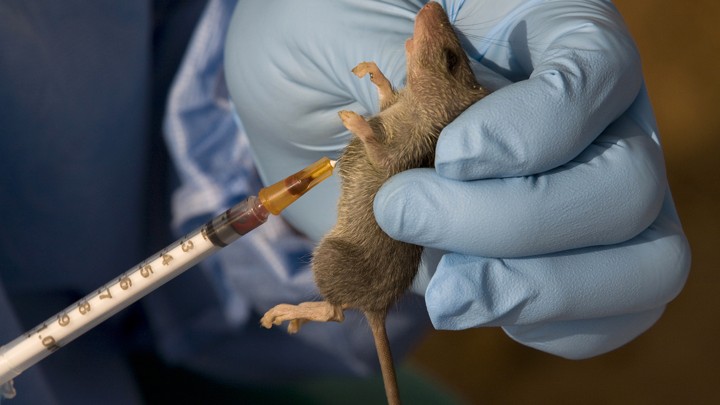
An ecologist extracts a sample of blood from a Mastomys Natalensis rodent in the village of Jormu in southeastern Sierra Leone February 8, 2011. Lassa fever, named after the Nigerian town where it was first identified in 1969, is among a U.S. list of "category A" diseases -- deemed to have the potential for major public health impact -- alongside anthrax and botulism. The disease is carried by the Mastomys Natalensis rodent, found across sub-Saharan Africa and often eaten as a source of protein. It infects an estimated 300,000-500,000 people each year, and kills about 5,000. Picture taken February 8, 2011. To match Reuters-Feature BIOTERROR-AFRICA/ REUTERS/Simon Akam (SIERRA LEONE - Tags: HEALTH SOCIETY ANIMALS) - GM1E72F07HC01
Feb. 2, 2025
The Nigeria Centre for Disease Control and Prevention (NCDC) fatalities from Lassa fever remains a concern, with 39 deaths recorded so far this year.
The agency disclosed this in its latest report where it said there’s a decline in confirmed Lassa fever cases for Epidemiological Week 3 of 2025
According to the report, confirmed cases fell from 89 in Week 2 to 71 in Week 3, with infections reported in Ondo, Edo, Bauchi, Taraba, Plateau, Ebonyi, Gombe, Nasarawa, Delta, and Kogi States.
Despite the decline in weekly cases, it said that the cumulative number of confirmed cases for 2025 has risen to 214, with an 18.2 per cent Case Fatality Ratio (CFR)—a slight decrease from 20.4 per cent recorded during the same period in 2024.
The NCDC noted that 77 per cent of confirmed cases originated from three states: Ondo (38 per cent), Edo (22 per cent)Bauchi (17 per cent)
The most affected age group, the agency said, was 21-30 years, with cases ranging from ages three to 94.
It said that no new healthcare worker infections were reported this week.
The agency further revealed that 10 states and 43 Local Government Areas (LGAs) have recorded at least one confirmed case this year, compared to 17 states and 54 LGAs in 2024.
To curb the outbreak, the NCDC activated a multi-sectoral Incident Management System and deployed National Rapid Response Teams to affected areas.
Other key interventions, it said included: “Enhanced surveillance and contact tracing, with 109 contacts under follow-up
“Training of healthcare workers on case management in Bauchi, Ebonyi, and Benue, with plans for Plateau and Taraba
“Distribution of medical supplies, including PPEs, Ribavirin, body bags, and sanitisers to treatment centres
“Community sensitization efforts in Bauchi, Ebonyi, and Edo States”.
The agency, in collaboration with partners, pledged to strengthen early detection, case management, and risk communication across the country.
Meanwhile, public health experts have warned that increased awareness and improved healthcare preparedness are crucial to reducing the burden of Lassa fever in Nigeria.
Authorities have urged Nigerians to adopt preventive measures, including proper food storage to prevent rodent infestation.
“Good hygiene practices, seeking medical attention at designated treatment centers if symptoms arise”.
The estimated fatality rate is one per cent, but during outbreaks, mortality can rise significantly, particularly among pregnant women and healthcare workers.