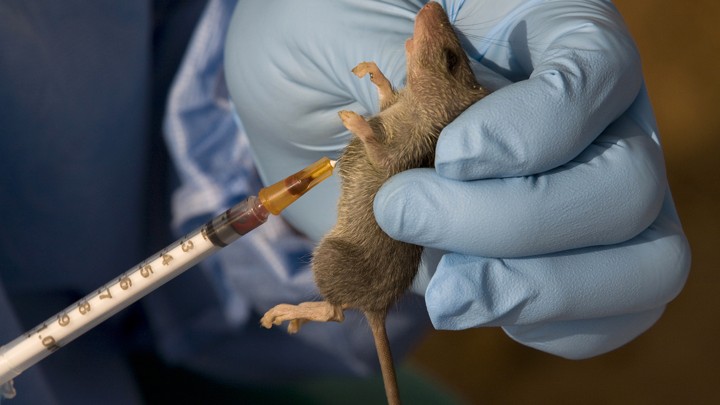
An ecologist extracts a sample of blood from a Mastomys Natalensis rodent in the village of Jormu in southeastern Sierra Leone February 8, 2011. Lassa fever, named after the Nigerian town where it was first identified in 1969, is among a U.S. list of "category A" diseases -- deemed to have the potential for major public health impact -- alongside anthrax and botulism. The disease is carried by the Mastomys Natalensis rodent, found across sub-Saharan Africa and often eaten as a source of protein. It infects an estimated 300,000-500,000 people each year, and kills about 5,000. Picture taken February 8, 2011. To match Reuters-Feature BIOTERROR-AFRICA/ REUTERS/Simon Akam (SIERRA LEONE - Tags: HEALTH SOCIETY ANIMALS) - GM1E72F07HC01
The Nigeria Centre for Disease Control and Prevention (NCDC) has recorded 135 deaths from Lassa fever as of Epidemiological Week 10 of 2026, with the case fatality rate rising to 26.2 per cent, according to the latest situation report.
The NCDC disclosed this on Friday in its Lassa Fever Situation Report for Epidemiological Week 10 (2nd – 8th March, 2026).
The report indicates that the fatality rate is significantly higher than the 18.3 per cent recorded within the same period in 2025, raising fresh concerns among public health experts.
It stated that although the number of confirmed cases declined in the reporting week, the death rate remained a major concern.
“In week 10, the number of new confirmed cases decreased from 65 in Epidemiological Week 9 to 40,” the report noted.
The report showed that the confirmed cases were recorded in Bauchi, Ondo, Taraba, Benue, Edo, Kogi, Gombe and Cross River states.
Cumulatively, Nigeria has recorded 516 confirmed cases and 2,821 suspected cases across 20 states and 78 local government areas as of week 10.
The report further revealed that five states; Bauchi, Ondo, Taraba, Benue and Edo accounted for 85 per cent of all confirmed cases, indicating persistent hotspots in these areas.
A breakdown showed that Bauchi accounted for 28 per cent of confirmed cases, followed by Ondo (21 per cent), Taraba (19 per cent), Benue (9 per cent) and Edo (8 per cent).
According to the data, the most affected age group is 21 to 30 years, with cases ranging from 1 to 90 years and a median age of 30 years.
It added that the male-to-female ratio for confirmed cases stood at 1:0.9.
The report identified late presentation of cases, poor health-seeking behaviour, high cost of treatment, and poor environmental sanitation as key factors contributing to the rising fatality rate.
It also noted low awareness levels in high-burden communities and occasional infections among healthcare workers as ongoing challenges.
It however, noted that no new healthcare worker infection was recorded in the reporting week.
To contain the outbreak, the agency said it had activated a multi-partner, multi-sectoral Incident Management System to coordinate response activities nationwide.
It listed response efforts adopted to include deploying National Rapid Response Teams to high-burden states, distributing personal protective equipment, providing treatment commodities such as Ribavirin, and strengthening surveillance and contact tracing.
The report also highlighted ongoing collaborations with partners, including the World Health Organisation, Médecins Sans Frontières, and the U.S. Centers for Disease Control and Prevention (US CDC), to support outbreak control measures.
The NCDC has urged state governments to intensify community engagement and awareness campaigns, while advising healthcare workers to maintain a high index of suspicion and adhere strictly to infection prevention and control protocols.
It also called for strengthened capacity at the state level to ensure timely detection and response to Lassa fever cases.
Lassa fever is an acute viral haemorrhagic illness caused by the Lassa virus and is primarily transmitted through contact with food or household items contaminated by rodents.
Health authorities said early detection, prompt treatment and strict infection control measures remain critical to reducing mortality and preventing outbreaks.