
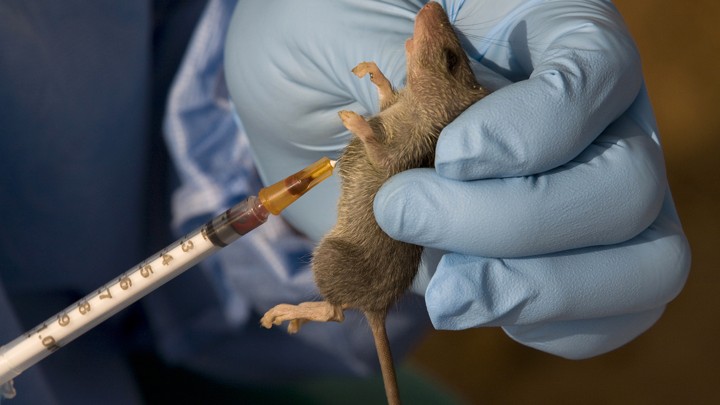
An ecologist extracts a sample of blood from a Mastomys Natalensis rodent in the village of Jormu in southeastern Sierra Leone February 8, 2011. Lassa fever, named after the Nigerian town where it was first identified in 1969, is among a U.S. list of "category A" diseases -- deemed to have the potential for major public health impact -- alongside anthrax and botulism. The disease is carried by the Mastomys Natalensis rodent, found across sub-Saharan Africa and often eaten as a source of protein. It infects an estimated 300,000-500,000 people each year, and kills about 5,000. Picture taken February 8, 2011. To match Reuters-Feature BIOTERROR-AFRICA/ REUTERS/Simon Akam (SIERRA LEONE - Tags: HEALTH SOCIETY ANIMALS) - GM1E72F07HC01
Feb. 27, 2024
The Kaduna State Government has confirmed five deaths following Lassa Fever outbreak in the state.
The confirmation is in a report on the outbreak of the disease made available to the News Agency of Nigeria (NAN) by the state’s Commissioner for Health, Hajiya Umma Ahmed, on Tuesday in Kaduna.
She stated that an initial six samples were collected to confirm the outbreak, followed by another six samples from contacts, which were sent to Bayero University Kano for analysis, “with a 24-28 hours turnaround time for the result.”
She indicated that the index case was a 26-year-old youth corps member who took ill on Feb. 9, presented at the 44 Army Reference Hospital
but died on Feb. 20.
“Symptoms presented included fever, headache, convulsion and bleeding.
“Thereafter, a total of 32 suspected cases were line-listed and samples collected. Six cases were confirmed positive, with five deaths and
a male – female ratio of 1:1.
“The result also showed five were negative, while 21 results are being awaited.”
According to the report, 99 contacts have so far been line-listed and are being followed up, as 19 others also developed some form of symptoms and their samples collected.
The commissioner said that the state government had so far taken some measures to combat the outbreak of the disease.
She listed the deployment of state and local government areas’ Rapid Response Team, and activation of Incident Management System at the Infectious Disease Hospital, Mando, Kaduna.
Some other measures taken, Ahmed said, were the supply of rodent equipment by the Nigeria Centre for Disease Control (NCDC), as well as interventions for rodent control by a team from the Federal Ministry of Environment, in collaboration with state team.
She listed challenges encountered in combating spread of the disease to include late presentation of patients to hospital, poor adherence to infection prevention control in health facilities and non-adherence to the use of triage points.
She reiterated the state government’s determination to intensify surveillance at all levels, as well as follow-ups on listed contacts.
She added that “though Lassa Fever is contagious and fatal, adherence to Infection Prevention Control and an early presentation
will reduce mortality.”(NAN)