
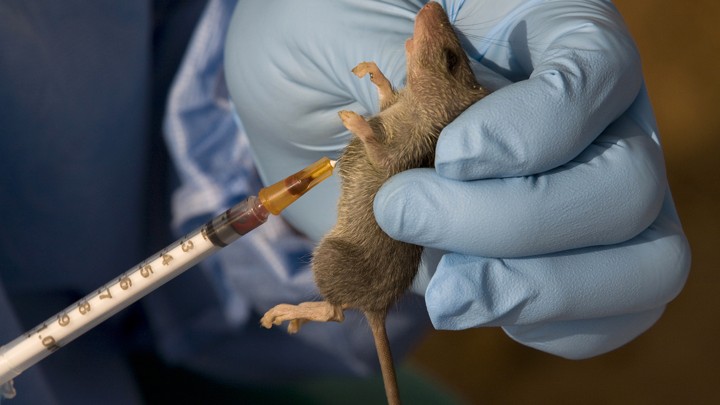
An ecologist extracts a sample of blood from a Mastomys Natalensis rodent in the village of Jormu in southeastern Sierra Leone February 8, 2011. Lassa fever, named after the Nigerian town where it was first identified in 1969, is among a U.S. list of "category A" diseases -- deemed to have the potential for major public health impact -- alongside anthrax and botulism. The disease is carried by the Mastomys Natalensis rodent, found across sub-Saharan Africa and often eaten as a source of protein. It infects an estimated 300,000-500,000 people each year, and kills about 5,000. Picture taken February 8, 2011. To match Reuters-Feature BIOTERROR-AFRICA/ REUTERS/Simon Akam (SIERRA LEONE - Tags: HEALTH SOCIETY ANIMALS) - GM1E72F07HC01
Feb. 18, 2025
The Nigeria Centre for Disease Control and Prevention (NCDC) has reported a decline in confirmed Lassa fever cases for Epidemiological Week Five Jan. 27 – Feb. 2, 2025, according to its latest Situation Report.
The NCDC, via its official website, said that the Case Fatality Ratio (CFR) has increased compared to the same period in 2024, raising concerns about the severity of the outbreak.
The NCDC’s report revealed 68 new confirmed cases across seven states, Ondo, Bauchi, Edo, Taraba, Kogi, Gombe, and Ebonyi marking a decline from 76 cases in the previous week.
Cumulatively, by Week 5 of 2025, there have been 358 confirmed cases and 70 deaths, with a CFR of 19.6 per cent, which is higher than the 19.2 per cent recorded in the same period in 2024.
The report highlighted that 75 per cent of all confirmed cases originated from Ondo 37 per cent, Edo 20 per cent, and Bauchi 18 per cent.
“The disease has spread to 10 states, spanning 58 Local Government Areas (LGAs), with the predominant age group affected being 21–30 years.
“Alarmingly, three healthcare workers were infected in the reporting week.”
“The NCDC has activated a multi-partner, multi-sectoral Incident Management System (IMS) to coordinate response efforts, including deploying National Rapid Response Teams, conducting active surveillance, distributing medical supplies, and training healthcare workers in high-burden states.
“In spite of these efforts, challenges persist, such as late presentation of cases, poor health-seeking behaviour, high treatment costs, and poor sanitation in affected areas.”
“The agency continues to work with partners to strengthen case management, surveillance, and prevention strategies.
“For further updates and prevention guidelines, the public is encouraged to visit the NCDC website at www.ncdc.gov.ng or call the NCDC toll-free helpline at 6232,” it said.