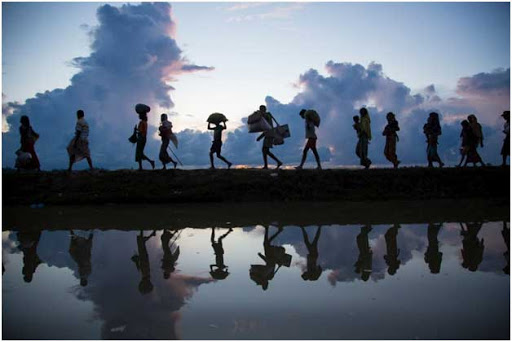
Migrants: A depiction

Deep in Morocco’s fertile heartlands, pickup trucks carrying migrants from sub-Saharan Africa roll past a sea of plastic greenhouses producing fresh fruit and vegetables for supermarkets across Europe and West Africa.
Some of these workers – largely from French-speaking West Africa – intended to head to Europe but are now putting that off to take up work in Morocco and plug a growing gap in domestic farm labour.
The trend underscores Morocco’s changing role in international migration flows into more of a destination than a transit country, and factors into recent declines in attempted crossings to Europe.
Continued tougher border controls, and opportunities for migrants to work in agriculture as rural Moroccans increasingly migrate to cities for jobs in construction and services, could consolidate the shift.
The Chtouka plains in the Souss-Massa region, 50 km south of the seaside city of Agadir, encapsulate the changing dynamics.
Over 24,000 hectares of greenhouse farming produce more than four fifths of Morocco’s fruit and vegetable exports, contributing to a 3.6% rise in the country’s agricultural exports to $4.5 billion last year.
“Working is better than asking for charity in the streets,” he told Reuters after a shift at a tomato farm.
LABOUR SHORTAGES
The trend, which is hard to quantify since official statistics do not reflect informal migration, has been driven by changing economic and social conditions, according to farmers and officials.
After years of drought, many young Moroccans have moved to cities, attracted by the expanding construction and services sectors.
That has led to fewer Moroccans employed in agriculture, a sector that has shed 1.7 million jobs overall since 2000 as subsistence farming has declined, according to official statistics.
Today just one in four Moroccans work in farming, compared with half of Moroccans two decades ago.
Those who do stay often ask for higher wages or prefer to be paid for “piecework,” meaning they are paid for each box filled or row of crops harvested, according to farmers.
This can push up wages up to as much as 500 Moroccan dirhams ($55) per day – more than five times what migrants such as Aliou earn.
At the same time, some farmers have shifted to more labour-intensive, export-oriented cash crops such as strawberries, raspberries and blueberries.
“Without Sub-Saharan labour, a number of farms could have shut down or been forced to reduce output,” said Abdelaziz El Maanaoui, head of a producers’ association in the Chtouka plains.
Sub-Saharan labour is mostly informal though more than 50,000 migrants have gained legal status in Morocco since 2013.
El Maanaoui said he supported easing paperwork to help farms legally hire migrant workers, especially since labour shortages may deepen as Morocco’s fertility rates – now below replacement level at 1.9 children per woman – decline.
Morocco’s spending on railways, roads, stadiums and airports ahead of the World Cup it will co-host in 2030 is also expected to reach some 190 billion dirhams ($20 billion) over the next four years, or about 12% of GDP.
That will draw even more workers from villages into cities.
“Once people get used to urban life, it is hard to bring them back to work on farms in rural areas,” said Rachid Benali, head of the national farm producers’ confederation, COMADER.
He said a “structural shortage of both qualified and unqualified agricultural labour across the country” risked putting the sector’s competitiveness at risk.
“Morocco no longer has the advantage of cheap labour,” he said.
CHANGING DEMOGRAPHICS
Alioun Dialou, 48, a Senegalese national who has worked on Moroccan farms since 2008, has seen the changes reshape Ait Amira.
The town’s population has quadrupled over the past three decades to 113,000, driven in large part by the arrival of migrant labourers.
As Moroccan workers have aged, sub-Saharan migrants have increasingly taken their place, Dialou said, speaking near his home in an informally built neighbourhood in Ait Amira. At dawn, they often gather at a spot known as the “Mouqf” – the “standing place” – on Ait Amira’s main road, waiting to negotiate a day’s wage with truck drivers who take them to greenhouses.
Many services are lacking in the area, which saw some of the most violent unrest during youth-led protests last October.
Though Dialou once planned to head to Europe, he now intends to stay. He has an 11-year-old daughter in a local school who speaks both Amazigh and Moroccan Arabic.
Some migrants, like Dialou, may settle long-term in Morocco – though others say they still have Europe in mind.
Aliou, who earns about 100 dirhams a day, said he sleeps outdoors as he tries to save money to rent a room, and to buy sturdy shoes and a phone to stay in touch with the family he has not seen in four years.
“I have to earn some money to live and rest a little bit,” he said. “I will try Europe later.”
REUTERS