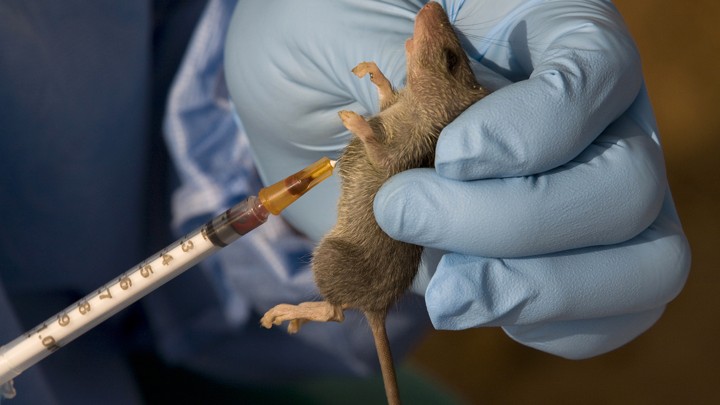
An ecologist extracts a sample of blood from a Mastomys Natalensis rodent in the village of Jormu in southeastern Sierra Leone February 8, 2011. Lassa fever, named after the Nigerian town where it was first identified in 1969, is among a U.S. list of "category A" diseases -- deemed to have the potential for major public health impact -- alongside anthrax and botulism. The disease is carried by the Mastomys Natalensis rodent, found across sub-Saharan Africa and often eaten as a source of protein. It infects an estimated 300,000-500,000 people each year, and kills about 5,000. Picture taken February 8, 2011. To match Reuters-Feature BIOTERROR-AFRICA/ REUTERS/Simon Akam (SIERRA LEONE - Tags: HEALTH SOCIETY ANIMALS) - GM1E72F07HC01
The Nigeria Centre for Disease Control and Prevention (NCDC), disclosed this in its latest report
The NCDC said the week 25 figure marks an increase from 17.6 per cent reported for the same period in 2024.
The report, which covered the week of June 16–22, revealed that 781 confirmed cases were reported out of 5,943 suspected cases across 20 states and 101 Local Government Areas (LGAs).
In the current reporting week, 10 new confirmed cases were reported in Ondo and Edo states with a slight increase from the eight cases recorded the previous week.
According to NCDC, 91 per cent of all confirmed cases in 2025 were reported from five states of Ondo (31%), Bauchi (24%), Edo (17%), Taraba (16%) and Ebonyi (3%).
It said that the disease continues to affect young adults predominantly, within the 21 to 30 age group most impacted. Males were slightly more affected, with a male-to-female ratio of 1:0.8.
The Nigerian public health agency, said that despite a decline in the overall number of suspected and confirmed cases compared to 2024, the rise in CFR is raising concerns among health experts.
The agency highlighted late presentation of cases, high treatment costs, and poor health-seeking behaviour as contributing factors to the increased fatality.
It said that no new infections among health workers were recorded in the reporting week, though 23 healthcare workers have been affected cumulatively this year.
The NCDC said it is currently in collaboration with partners, such as the World Health Organisation (WHO), the United States Centers for Disease Control and Prevention (US CDC), ALIMA, the Institute of Human Virology Nigeria (IHVN) and others.
The collaborations, it stated further have intensified multi-sectoral response efforts to combat the spread of Lassa fever.
It said that, as part of these efforts, Integrate clinical trials are currently ongoing in Ondo State, with After Action Reviews (AARs) conducted in both Ondo and Ebonyi to evaluate the response to the outbreak.
The agency said that clinician sensitisation, community engagement activities and environmental response campaigns have been carried out in identified hotspot areas.
In addition, the NCDC said that it has deployed 10 national rapid response teams to various states, adopting a one health approach to disease control.
To further strengthen infection prevention and control (IPC), the agency launched an IPC e-learning platform and distributed updated Viral Hemorrhagic Fever (VHF) guidelines to health facilities across the country.
The agency said that other efforts also included active contact tracing, surveillance, media engagement and geospatial risk mapping, alongside regular webinars for clinicians and capacity-building sessions nationwide.
The NCDC identified key challenges including poor environmental sanitation and low community awareness, particularly in high-burden LGAs.
It also said that sustained efforts were needed to curb the fatality rate, ensure early detection, and improve public health outcomes.
The NCDC advised Nigerians to maintain proper hygiene, avoid contact with rodents, and seek medical help promptly when experiencing symptoms such as fever, sore throat, vomiting, or unexplained bleeding.
That Lassa fever, which was first identified in 1969 in Lassa, Borno, is endemic in Nigeria, with outbreaks occurring annually.
Symptoms range from mild fever and joint pain to severe bleeding from the nose, mouth, and gastrointestinal tract.
The disease is fatal in about 20 per cent of cases, particularly when treatment is delayed.
Across West Africa, hundreds of thousands are infected annually, experiencing symptoms such as fever, vomiting and, in severe cases, bleeding.
One of the most troubling complications is hearing loss, which affects about 25 per cent of survivors.
The estimated fatality rate is one per cent, but during outbreaks, mortality can rise significantly, particularly among pregnant women and healthcare workers.
In spite its significant health impact, Lassa fever remains one of the most neglected diseases, with limited resources allocated to its preventions and treatments.
Currently, no licensed vaccines exist, although around 20 candidates are in development, with the most advanced in Phase IIa clinical trials.