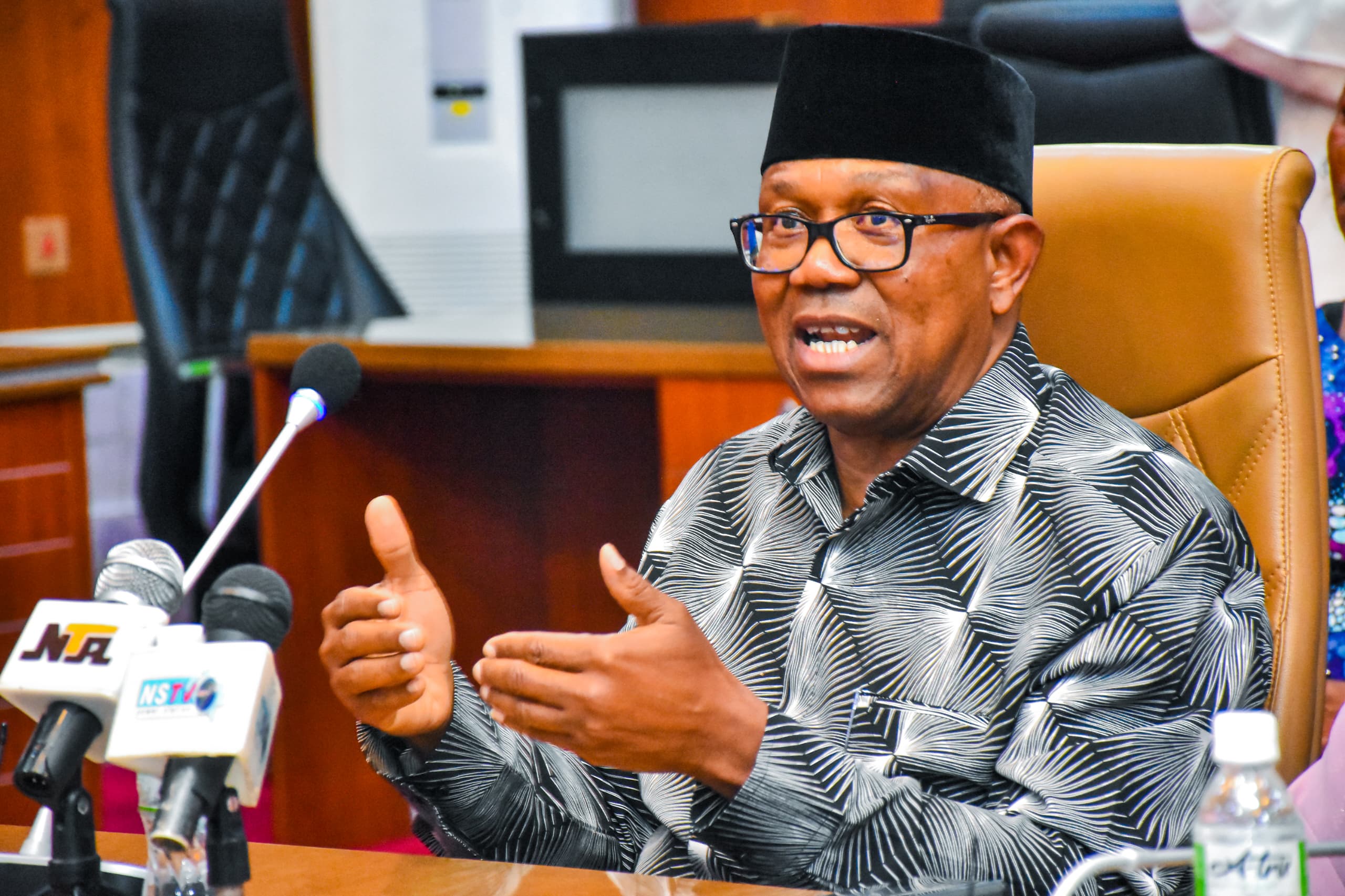
Peter Obi

Aeschylus’s “Seven Against Thebes” has often been described as a drama “chokeful of Ares” – a work saturated with martial tension, capturing the terrifying atmosphere of a city under siege, the panic of its citizens, and the constant clash of armed forces at its gates. It is a story of overwhelming pressure exerted upon a single entity, where survival depends entirely on resisting a coordinated assault from multiple fronts.
In a modern political sense, one can draw a direct parallel to the transformative journey of Mr. Peter Obi in Nigerian politics. His trajectory stands out as a defining narrative of Nigeria’s Fourth Republic, establishing him as the ultimate pioneer of judicial recourse in the nation’s executive history.
Not only was he the earliest governor to successfully reclaim a stolen mandate through the courts, but he also fortified that precedent by overturning an unconstitutional impeachment through judicial intervention. Most significantly, his subsequent pursuit of a constitutional interpretation regarding his tenure culminated in a landmark Supreme Court ruling. By declaring that a governor’s four-year term begins only when they take the oath of office, this single verdict irrevocably altered Nigeria’s political space, introducing the system of staggered gubernatorial elections.
Today, Obi operates within a highly charged, adversarial environment, continuously confronted by entrenched political interests, subjected to sustained hostility, and forced into a perpetual defensive posture. He stands as a titanic, lone figure navigating a crowded field of bitter, sometimes inhuman opposition.
Where does one begin in describing this hostility? It is a source of profound frustration that at the vanguard of this opposition is the government of his own home state of Anambra. With a furious energy, the incumbent Governor views Obi as a primary target. In several public remarks, the Governor has not concealed his deep displeasure toward him. This animosity persists despite the fact that Obi has not, in any sustained or direct manner, engaged him in confrontation. It raises a question often asked in political circles: what might the tone have been in the absence of Obi’s fierce grassroots supporters, who consistently serve as a protective buffer against this harsh political rhetoric? The organic army that stopped the rehearse of the part 11 of his essay.
From there, the siege expands outward to other prominent political actors across the country, each operating within their own selfish interests, strategic alliances, and narrow interpretations of Obi’s relevance.
Consider Engineer David Umahi. His outlook, often framed through a strongly Abakiliki lens, is frequently reflected in public remarks that tend to downplay Obi’s national profile. Seizing every opportunity to speak critically, Umahi consistently advances three main propositions: first, that President Bola Tinubu represents the most consequential leadership Nigeria has experienced in recent times; second, that opposition to his administration is fundamentally misguided and politically self-defeating; and third, that Peter Obi’s political influence is overstated and lacks national depth, with an implied suggestion that he himself possesses greater political weight and experience.
I think Umahi represents those typical Igbo men whose senses are blinded by ambition and whose political sanity is perpetually open to question. I recall what he did or received from Obi when Obi was the Vice Presidential candidate to Atiku, and the least support he ought to have offered was managing the campaign in Ebonyi, which he openly sabotaged after… The brief revelation by that woman regarding a contract executed for him shows how soulless he is and how he operates below qualities that could be genuinely considered human. He loves Tinubu more than he loves his father and mother. I heard him call Obi deceitful and speak about stopping a project based on what he heard from social media postings. What does he hope to achieve by amplifying such falsehoods? In fact, he is a clear danger to humanity and civilization.
Adjacent to these institutional struggles stands a relentless auxiliary of the press – a fierce coalition of detractors featuring Bayo Onanuga, Daniel Bwala, Reno Omokri, and Femi Fani-Kayode. Together, they function as a powerful engine of detraction, specializing in the art of public character assassination. With tireless persistence, they exhume old ghost-stories of scandal, amplify hostile narratives, and, when truth fails them as usual, simply manufacture new ones. They are known for concentrating acid in their inks, pouring out vitriol in full measure to burn any character they touch. Yet, despite the sheer weight of this onslaught, Obi’s reputation and personal integrity ultimately overpower their collective assault, leaving the core of his political identity remarkably unblemished. Thanks to “Obidients” who are more than equal to the task of standing up to them.
As if to outdo this quartet, Senator Adams Oshiomhole entered the arena. His morose outlook, gloomy disposition, and controversial travel history (Private jet) often place him at the centre of public debate. Politically, he began like Gabriel but is, in the words of some critics, in danger of ending like Lucifer. I recall when he was Governor of Edo State and seeking re-election; he practically prostrated (“dobale”) before Obi, pleading with him to come and campaign for him, publicly describing Obi as the best governor in Nigeria, whose testimonial would be beyond dispute. On that basis, Obi went to Edo State to campaign for him. Today, however, his tone has changed significantly, as he has made remarks questioning security under Obi’s tenure, despite contemporaneous reports – including assessments attributed to the Inspector General of Police – which ranked Anambra among the safest states in the country at the time.
Separately, there is Daleon Ademolake-Clarke, a lawyer and my classmate who has become a pro-Tinubu social media commentator. He leads a faction that regularly participates in and amplifies what many would consider unfounded narratives against Obi, whether through original posts or reshared content. In his efforts to defend Tinubu, he often engages in this digital contestation with considerable intensity. Most of those within this online classification, however, operate under anonymous or pseudonymous identities, because they consider what they do as “infra dig.”
There is the “City Boys” group – a loose network of individuals with varied perspectives, many of whom appear content with simply being associated with the ruling party, often with little concern for the ideological substance behind it. They are driven largely by the search for visibility, money to grab, belonging, and recognition within the social media space. Among its more prominent figures is Cubana Chief Priest, whom some loosely describe as “money without the man,” a phrase meant to capture the performative nature of influence within that circle. Their primary currency is attention. Together, they form an ecosystem that frequently recycles and amplifies negative propaganda, driven less by coherent conviction and more by the pursuit of engagement, clout, and relevance they lack honourable means of attracting. A significant number of participants in this space are also drawn from the diaspora, further expanding its reach and intensity. Left exasperated by the spectacle of their antics, Obi once remarked, and correctly so: “City boys! Is it only the East that has boys?”
Finally, we have a group that defies reason, often associated with Kenneth Okonkwo. Their positioning within the political discourse is fluid and, at all times, inconsistent. Some of the individuals in this class, whom I also describe as the dregs of society, include Jones Onwuasoanya, Iyke Orji, Chijoke Sam, Okeke Godwin Iyke, Oraegbunam Pajimo, Machi Pius Igwe, and Chukwuma Okafor. Their interventions often reflect opportunism, prompted by a lack of coherent direction. They are political “ikwurigbas” and “aturusokwunye ewu.”
In all of this, an undeniable pattern stands out: a sustained and coordinated hostility against a single figure, shaped by shifting alliances, political self-preservation, and evolving interests.
One must ask: What is Tinubu so afraid of that he must mass such unprecedented opposition against one man—a spectacle never before witnessed in the history of Nigerian political opposition? The President reminds me of the Roman Emperor Domitian, who was so consumed by the fear of conspiracy that he lined the walls of his porticoes with shining, polished stone, creating mirrors so that he might always see whatever went on behind his back. Tinubu must be the reincarnation of that paranoid sovereign. There is no apparatus he has not engaged to track, monitor, and desperately eyeball Obi’s every movement.
What, then, are Obi’s sins? His “sins,” if they can be called that, are remarkably simple. He has sought, as far as humanly possible, to wrong no man, even in the most trivial of matters. He has cultivated a reputation for personal discipline and moderation, rarely placing personal comfort above public duty. He has consistently preached prudence, accountability, and the careful management of scarce resources, insisting that government should serve the people rather than those who occupy public office. He has also demonstrated a capacity to distinguish between what is politically expedient and what is morally or economically sound, often choosing the latter even when it is unpopular.
Yet, in a political culture where excess is often celebrated, restraint becomes a crime; where patronage is the currency of power, frugality is viewed as a threat; and where politics is treated as a private estate, the insistence on transparency is seen as subversive. It would therefore appear that Obi’s greatest offence is not what he has done, but what he represents. His real “sin” is that, endowed with these qualities and enjoying considerable public appeal, he dares to aspire – within his constitutional rights – to the highest office in the land. In seeking the presidency, he challenges entrenched interests, unsettles comfortable arrangements, and offers an alternative vision of leadership. For many of his opponents, that appears to be an unforgivable transgression.
People love Peter Obi because of his undeniable antecedents. He was the lone governor who consistently advocated for national savings during the Jonathan administration, warning against a culture of consumption without production, and he went on to practise exactly what he preached. The people of Anambra State remain deeply grateful to him because he had the courage to confront – and, through difficult and sometimes painful decisions, substantially cure—m – the cancer of political disorder that once threatened to consume the state. He restored a measure of stability, fiscal discipline, and confidence in public administration, leaving behind a legacy that many still reference today.
Is it his fault that this affection has become contagious? Is it his fault that the admiration once confined to Anambra has, through the osmosis of shared experience and collective aspiration, spread across the nation? People did not wake up one morning and decide to support him out of sentiment. They looked at his record, weighed his words against his actions, and concluded that there was a rare consistency between the two. In a country where promises are abundant and performance often scarce, that consistency has become his greatest political asset.
This is why the relentless attacks on him have largely failed to achieve their intended purpose. The more his critics seek to diminish him, the more they inadvertently remind people of the qualities that first attracted them to him. His appeal is not founded on propaganda, ethnicity, religion, or the machinery of state. It is rooted in a perception that he represents competence, prudence, integrity, and hope. And ideas rooted in hope are notoriously difficult to defeat.
Perhaps that is the central lesson of this modern “Seven Against Thebes”. The story is not really about the seven who stand at the gates; it is about why they are there in the first place. The intensity of the opposition is itself a measure of the significance of the figure they oppose. If Peter Obi continues to command unusual attention from politicians, commentators, influencers, and power brokers alike, it is because they recognise what millions of Nigerians already recognise: that he remains a consequential force in the national conversation. Whether one supports him or opposes him, one cannot ignore him. And in politics, as in life, the surest evidence of relevance is not the number of friends one has, but the number of adversaries one compels to unite against him.