



Two revolutionary hinges: Obi and Sowore, by Valentine Obienyem
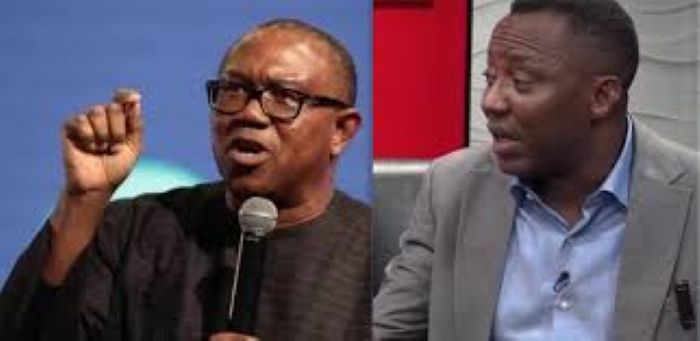
I first became aware of the exploits of Mr. Omoyele Sowore during his days as a student activist. At 54, I believe we belong to roughly the same generational cohort. Over the years, I have followed his trajectory with mixed feelings – at times with admiration, at others with a measure of unease – particularly through Sahara Reporters. The platform, in my observation, has often been sharply critical of Mr. Peter Obi. My first personal encounter with Sowore was in Rhode Island, at a symposium organised by Chinua Achebe at Brown University, Providence, United States, around 2012.
Like most of us, he has grown with age and experience. To be honest with myself, I must acknowledge that I have come to admire what Omoyele Sowore represents in recent times. Have you watched his press conferences lately? While speaking, one can immediately detect that he possesses a mind filled with enthusiasm and ardour for action. He appears ready to carry the revolutionary mantle, provided the people are willing to rally behind him. He is always execrating tyranny with declamatory passion and enthroning liberty as nobler than life.
In many respects, he stands as the closest contemporary parallel to Gani Fawehinmi: fearless in activism, unapologetic in his voice, and remarkably consistent in his call for systemic change, even revolution. From his activism, one could detect the puritan zeal of Martin Luther, a relentless drive to confront corruption and to call for a moral and structural cleansing of the system, regardless of the consequences. The vices he confronts publicly are the very ones many Nigerians privately resent, yet often choose not to challenge for their peace of mind. What is apparent today, as always, is that many Nigerians are too weak of wing for a revolutionary flight. But let us even ask: does Nigeria truly need a revolution?
Yes, if by revolution we mean the weeding out of the evil structures that have produced our present condition, so that something new may be built in their place. I have myself, in earlier writings and even in my philosophical dissertation, engaged revolution as a necessary rupture with a broken order. Few honest observers, seeing Nigeria today, can deny the grief or the desire for a fundamental reset of the status quo. Yet revolution is not only about destruction; it can also be gradual, strategic, and almost imperceptible so that transformation is completed before the old order fully understands what has happened.
In Nigeria today, the two most visible currents of reformist energy are represented by Mr. Sowore and Mr. Peter Obi. Sowore is younger, more impatient, and believes change must come through immediate and total rupture. It may sound incredible, but it is true that around him are figures such as VeryDarkMan, Aisha Yesufu, Mama P, Peter Randy Akah, Mazi Odera, Tai, Maccool, Charly Boy, the Obidients, Magnus Oraka, Dr. Akpoki, Tanko Yunusa, Kingland, Dele Farotimi, Femi Falana, Aluta, and many other Nigerians who embody a deep and often righteous anger at a country that persistently knows the right thing yet repeatedly does the opposite.
On the other hand, there is the more restrained but equally influential current represented by Peter Obi. Those queuing behind Sowore only see Obi as the best available vehicle towards the ultimate destination. Obi is more mature in temperament, shaped by experience within governance, and inclined toward institutional engagement. He speaks consistently and forcefully about Nigeria’s structural and moral decay with greater persistence than most political actors. His method is more strategic, measured, and reformist rather than disruptive. His daily tweets have become a tocsin, calling on the government to recognize the impunity they commit daily while prescribing a rational course of action. If his approach is not impactful in its own way, why is he so often the most attacked – or even the only attacked – opposition figure? Once he tweets or makes an observation, e-rats, paid by the government, sally together to attack him like antibodies gathering to attack an infection. Indeed, his tweets have become bulwarks against the insolence of those in power. Have you not noticed that content creators across social media in Nigeria frequently draw upon the ideas in his tweets?
If Omoyele Sowore represents revolutionary fire, Peter Obi represents disciplined caution. The tension between them is therefore not merely personal but philosophical: if all is fire, society burns; if all is cold, society freezes. We shall return to resolving that tension later.
Is Sowore’s relentless attack on Obi the way to resolve that tension? One can easily distil three strains in what he says about Obi: moral outrage, revolutionary impatience, and a suspicion of compromise. He speaks doubtfully of the money Obi left behind, suggests that Obi is living outside Anambra because he did not do much to improve it, and argues that Obi cannot be disentangled from the “bad company” he keeps.
As Governor, his record remains unequalled. Many years after he left office, ThisDay Newspapers crowned him the Best Governor of the Decade. As Governor, Obi was unarguably a progressive force, establishing political stability after the initials up and down, restoring order, protecting life and property, reassuring the people, aiding industry; he advanced half a century during his eight years in the saddle. It is difficult to deny that his administration left a distinct imprint of restraint and efficiency, even among critics.
Contrary to what Sowore says, Obi left the funds he claimed and owed no kobo to anyone upon leaving office. Those who assert that the money was already encumbered are not being truthful to themselves. Many years later, the former Governor of Taraba State, His Excellency Darius Ishaku noted that former Governor Willie Obiano told him it was the money Obi left that he used to build an airport. We also know to whom the dollars were sold and at what rate. This is the line of inquiry that figures like Sowore should pursue, rather than attacking a man he should see as a partner in progress. Regarding residency, Obi has lived in Onitsha since leaving office and merely visits Lagos, Abuja, and other locations from that base.
With an exaggeration of indignation, Sowore called Obi “a packaged fraud.” He sometimes frames Obi’s measured and mature approach as compromise, accusing him of “dining with the forces of destruction.” He occasionally regards such measured actions as a gentlemanly protest, easily forgotten and unlikely to bear substantial fruit. This reflects a deeper philosophical divide between reform from within and rupture from without. Let us turn to the history of the Reformation to make this point clearer.
History offers a useful analogy. Desiderius Erasmus advocated internal reform of the Church when the institution was in decay, believing that renewal could occur without total breakdown. He had his points. Martin Luther, influenced by the urgency of reformist critique, pursued a rupture that permanently divided Christendom – a division from which it has yet to fully recover, as evidenced by the fragmentation of Christianity into countless sects. Today, Erasmus is still accused of having laid the eggs that Luther hatched. The tension between Erasmus and Luther, in some sense, mirrors the tension between Obi and Sowore.
Obi’s approach resembles that of Desiderius Erasmus: cautious reform, institutional engagement, and gradual correction of decay. He dines with some purveyors of darkness without being contaminated by them. Sowore’s approach resembles that of Martin Luther: confrontation, rupture, and the belief that the system itself may be too compromised for slow repair. Who is right? Both are, but remember: if we are too hot, we will all get burnt; if we are too cold, we shall be frozen.
But disagreement does not justify hostility. The intensity of attacks directed at Obi often appears disproportionate and, more often than not, analytically weak. Critique becomes particularly problematic when it shifts from engagement with facts to the creation of suspicion as a default posture. This has led some to believe that Sowore is merely a rabble-rouser, driven by an elevated passion for fame. When public discourse begins to treat all actors as morally indistinguishable, it risks collapsing into cynicism. At that point, activism loses its critical edge and becomes virtually indistinguishable from the posturing of figures like Reno Omokri, Femi Fani-Kayode, and Daniel Bwala. They are nurturing misguided progenies like the Adichies and Ejimofors of this world.
Within the wider activist ecosystem, voices like Mama P often express admiration for Sowore’s courage, commitment, and passion. Yet, they also question the necessity of direct hostility toward Obi. Did you notice that she challenged Sowore only with difficulty? It raises a fundamental question: why should opposition forces turn on one another, leaving the common enemy unchallenged, when their energies should be aligned toward shared objectives? Many observers therefore argue that both streams of energy, the fiery, uncompromising drive of Sowore and the measured, strategic engagement of Obi, should be viewed as complementary rather than antagonistic. When properly channelled, these currents of activism could reinforce each other, creating a synergy capable of challenging entrenched corruption, advancing structural reform, and holding power to account. By allowing internecine conflict to dominate the discourse, the activist community risks dissipating its collective energy, weakening its moral authority, and undermining the very causes it seeks to champion. In short, collaboration, not confrontation, may well be the most revolutionary act of all. What would it be like, and how would Nigerians react, if Sowore’s battle cry now were: “My elder brother, Mr. Peter Obi, if the ADC frustrates you, come to our party”?
The deeper issue, then, is not Sowore versus Obi as personalities, but how a society manages the balance between revolutionary urgency and reformist patience. As Aristotle reminds us, virtue often lies in the mean between extremes. By applying the concept of the mean, we shall avoid being burnt by the fire or frozen by the cold.
The writer does not claim certainty about the path forward. But it is increasingly clear that Nigeria’s renewal will not be achieved through antagonism among its reform-minded actors. Whether through confrontation or gradualism, both energies may ultimately be necessary.
Perhaps the real danger is not disagreement itself, but the possibility – just a possibility – that Mr. Peter Randy Akah’s Master Strategist is at work, subtly sowing seeds of discord here and there. The real challenge, therefore, is not simply choosing between fire and caution or Sowore and Obi, but recognising when external forces manipulate these energies for strategic advantage. The survival and renewal of Nigerian democracy may ultimately depend on the ability of its reformist and revolutionary actors to maintain cohesion, exercise discernment, and direct their collective action toward genuine reform rather than internal fragmentation.
Obienyem wrote this piece from Lagos