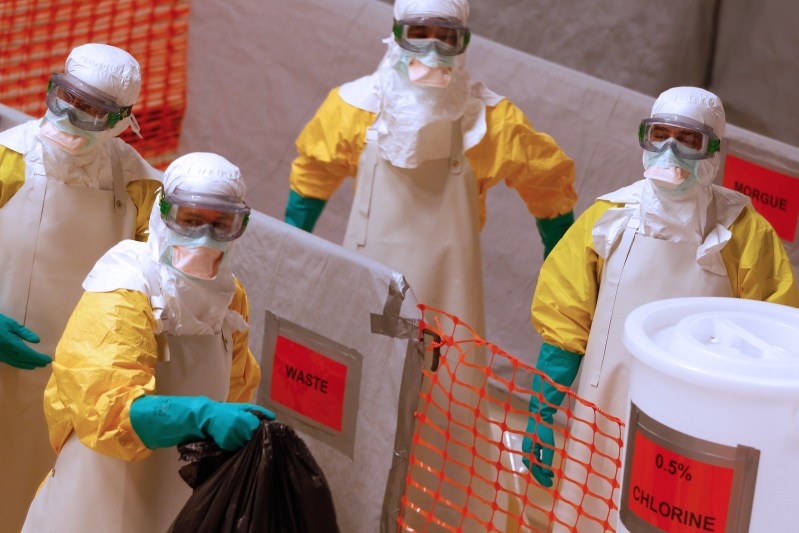
Medical workers wearing protective suits take part in a training prior to leave to countries affected by the Ebolas virus, in an empty factory warehouse in Amsterdam, on November 5, 2014 where medicals aid group Medecins Sans Frontieres (MSF) created a mock clinic. The disease has killed nearly 5,000 people, almost all of them in Sierra Leone, Liberia and Guinea. AFP PHOTO/ANP/BAS CZERWINSKI-netherlands out- (Photo credit should read BAS CZERWINSKI/AFP/Getty Images)
Richard Valery Mouzoko Kiboung, an epidemiologist employed by the UN’s World Health Organization (WHO), was gunned down in April 2019 at a work meeting at a hospital in Butembo, in North Kivu province.
He was one of many foreign medical workers who had been brought in to help fight an epidemic of Ebola in eastern DR Congo that claimed more than 2,200 lives before it ended in June 2020 after 22 months.

A military court in North Kivu on Monday handed down the death sentence to 16 fugitives, including Dr. Jean-Paul Mundama, who were charged with terrorism and criminal association, attorneys familiar with the case said.
The Democratic Republic of Congo has not carried out executions since a moratorium was declared in 2003.
Local doctors earned an Ebola bonus of $20 per day, whereas foreign doctors in senior positions could pick up more than $20,000 per month, according to an investigation last December by a news website, Les Jours.
After meeting with four other local doctors who were angry about the different status, Mundama allegedly gave $700 to a former militiaman, with the promise of $20,000 more, if he and others “got the foreigners to flee,” Les Jours said.
Eight other defendants were present at the weeklong trial.
Of these, two militiamen were jailed for five years, and a second doctor, Gilbert Kasereka Kasisivahwa, was handed three years for criminal association.
The international response to the 2018-20 Ebola epidemic, the 10th in DRC’s history, has been subject to much scrutiny.
Tens of millions of dollars poured into a remote region in a poor country, creating work opportunities for many, such as in logistics and tracing.
But it also stoked rivalries and jealousies between staff from the region and those from the DRC capital Kinshasa, and also between DRC hires and foreign hires.
AFP