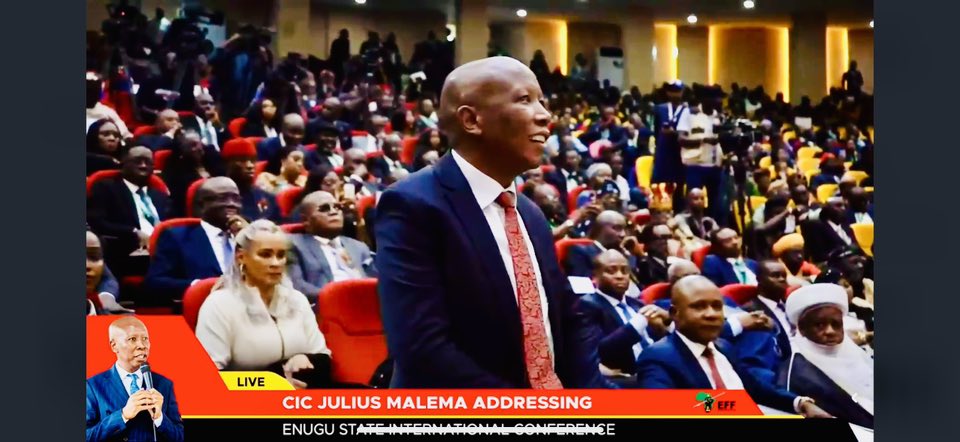
Julius Malema addressing the NBA conference in Enugu
We want the land of Africa returned to Africans. We want African minerals restored to the continent because they belong to our people,” the founder and leader of the Economic Freedom Fighters (EFF), declared to the tumultuous affirmation of the audience.

Feisty South African opposition leader, Julius Malema, stole the show Sunday in Enugu when he rallied African nations to unite against external forces seeking to divide them and subject them to exploitation.
Malema who spoke at the opening of the 2025 Annual General Conference of the Nigerian Bar Association (NBA) held at the International Conference Centre, Enugu pointed Africans to a neo-colonisation of the continent by external forces intent on keeping the continent only as their source of raw materials and all forms of material enrichment. The theme was ‘Stand Out and Stand Tall’.
He drew ovation after ovation as he ploughed through the maze of exploitative tendencies of external influences who are only interested in the resources out of Africa and not in her real development.
“We want the land of Africa returned to Africans. We want African minerals restored to the continent because they belong to our people,” the founder and leader of the Economic Freedom Fighters (EFF), declared to the tumultuous affirmation of the audience.
Africa must rise and build industries in Africa to process its natural resources locally, he asserted.
His message resonates with the local content policy of the Nigerian government, a policy that promotes ‘Buy Nigeria, and ‘Eat Nigeria.’
He believes that Africa possesses the capacity to industrialise and must stop the continuous extraction of its resources by imperialist forces bent on maintaining dominance.
He presented a trove of measures that Africa must take for its economic redemption.
He demanded a borderless continent. “We want one Africa — with one president, one currency, one military command and one parliament,” he said.
He argued that a unified African currency would be stronger than the American dollar, adding: “We are not subjects of foreign policies.”
Malema urged Africans to present themselves as one people, equal to world powers such as China, Russia, and America, and not as a fragmented continent.
“We are not a dark continent. How can we be dark when diamonds shine among us? We are a shining nation.
“Our salvation will not come from Washington, London, Brussels, or Beijing. It lies in Africa itself,” he stated.
Malema called for stronger Nigeria–South Africa cooperation to transform the African Continental Free Trade Area (AfCFTA) from a mere document into a reality improving citizens’ lives.
“Together, we can demand fair trade, protect industries, and invest in education, technology, and innovation. Africa is not a begging power but a continent of giants,” he said.
The freedom fighter was a hallmark of gratitude as he openly extolled Nigeria’s contributions towards ensuring South Africa’s freedom from apartheid.
He condemned xenophobia in South Africa, calling it “a betrayal of African unity”.
Recalling that Nigeria was one of the countries that stood firmly by South Africa, during that country’s darkest hour, Malema said: “I must reiterate once again that it is a deep honour to stand before you today in Enugu State in Nigeria, a country that holds a special place in the hearts of all South Africans.
“We understand history, feel solidarity and appreciate the sacrifice made by others in the course of our history. Nigeria is not just another African country to us”.
He recalled that when South Africa was shackled by apartheid and their people were murdered, imprisoned, and denied basic humanity, Nigeria rose as a giant for justice, placing his country squarely at the centre of its corridors.
According to him, Nigeria set up the Southern African Relief Fund and mobilised its citizens to contribute to the liberation struggle.
“Even as it faced its own challenges at home, these initiatives raised millions of dollars to support the liberation of South Africa as people paid directly from their salaries to contribute to the liberation struggle.
“Nigerian students sacrificed a portion of their income, through the Mandela Tax,
which supported an educational training programme for Black South Africans.
“A successive Nigerian government never stopped in their material and moral support for South Africa’s liberation.
“In fact, Nigerian government boycotted the 1976 Olympic Games and the 1979 Convention of the Multiculturalists,” Malema recalled.
He said that Nigerian students did not only contribute money through Mandela Tax, but also, protested their rage and opposition to apartheid.
“We can neither forget all those who stood by us during difficult times, nor can we forget that when Nelson Mandela was released from prison in 1990, one of his earliest international visits was Lagos and Abuja to personally thank the Nigerian people.
“These gestures are the foundation of a bond sealed in blood and sacrifice. However, this history must not remain in the past.
“This bond between South Africa and Nigeria must be carried forward into the present, not just in political sentiment but in concrete economic collaboration as both our nations stand as giants of the continent,” he said, drawing more applause.
He proposed stronger collaboration between the two nations in mining, advanced infrastructure, financial system, entrepreneurial spirit, oil and gas resources and cultural dynamics.
“Together, we hold the keys to Africa’s industrialisation and economic independence when we consider what lies beneath our soils. Nigeria is blessed with abundant oil, natural gas, and growing agricultural sector. South Africa holds some of the richest deposits of platinum, gold, manganese, and coal in the world. Combined, we possess the minerals that power modern technology, the energy resources that fuel global industry and the human capital to build a self-sufficient continent,” he said.
Malema said that despite all the potential, abundance natural resources, yet, both nations “remain strapped in neo-colonial arrangements where our raw materials are extracted cheaply
“These raw materials are exported to Europe, America, and Asia only to be sold back to us at crazy prices as finished goods,” he decried.
According to him, both countries can build factories and process their resources on African soil.
“Imagine a joint programme where South African mining expertise is combined
with Nigerian oil wealth, to create African-owned energy and resources.
“Imagine agricultural cooperation where Nigerian fertile lands provide food security for the continent, supported by South African machinery, logistics, and technology.
“Imagine a collaborative investment in renewable energy, where South African
solar potential and Nigeria gas reserves are harnessed to build an integrated African power grid,” he said.
Malema noted that South African companies such as MTN, SPAR, Multi choice and others had made significant progress in Nigeria through creation of jobs and services.
He also said that the Nigerian businesses and investors, and cultural industries had equally expanded to South Africa, stressing that Nigerian music, films and writings influence South African culture.
Malema decried the painful experience of xenophobia, denouncing South Africa’s hostility and discrimination against Nigerians and citizens of other African countries, manifesting in violence, killings, looting, and attacks on their businesses.
He described xenophobia as a betrayal of African unity and a sickness born of poverty.
In their remarks, the Sultan of Sokoto, Sa’adu Abubakar and Enugu governor, Peter Mbah, urged lawyers to defend justice and protect the poor.
The Sultan urged lawyers to ensure that law fulfils its objectives by promoting justice, protecting rights, resolving disputes, and providing a framework for social progress; adding that law fosters economic and social development by creating a predictable environment for transactions and driving social change through responsive legislation.
Without law, societies risk chaos, lacking mechanisms to govern relationships, enforce rules, and guarantee fairness or accountability, the Sultan said.
“Today, justice is becoming a purchasable commodity. The poor suffer miscarriages of justice, while the rich commit crimes and freely walk the streets,” he said.
Gov. Peter Mbah while declaring the conference open, said his administration was building a justice system that was fair, functional, and trusted by the people.
Mbah highlighted his government’s reforms, including financial autonomy for the judiciary, in line with the 1999 Constitution (as amended), to ensure efficiency and independence of the courts.
He noted that courts had been rehabilitated and digitised across Enugu’s three senatorial zones, with the High Court Complex now equipped with e-filing facilities.
He added that the Enugu Multi-Door Courthouse had been expanded and strengthened, making it a model for commercial and family dispute resolution in the region.