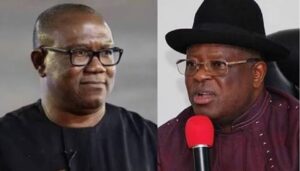
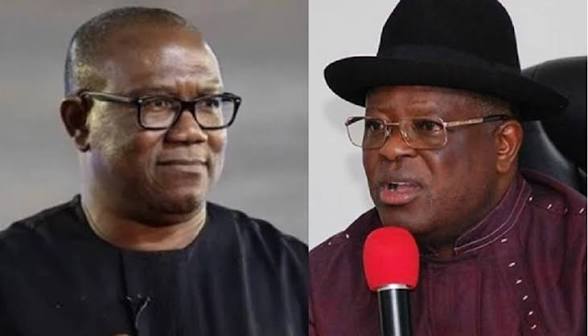
Peter Obi and David Umahi
It is clear, even to the deaf, that Mr Peter Obi is the most popular Nigerian today. His popularity was gradual, sustained, and is today absolute. It was nurtured by his remarkable life, his service as Governor of Anambra State, and the steady revelation of his character.
As governor, he was distinct from his peers – conscientiously absorbed in the enterprise of governance and devoted, almost recklessly, to the welfare of the people. There are so many positive things to say about Obi that a quire of paper could not contain his praises.
In appearance and manners, he is calm, reserved, and soft-spoken. His friends know him as a man of immense personal warmth and charm. In politics, however, he is an able and energetic campaigner possesses an iron will, and maintains a fierce determination to win every contest without resorting to rigging.
More than many contemporary politicians, he has cultivated a tranquillity born of self-control. He rarely replies to the insults hurled by the Umahi tribe, choosing instead to deal with ideas rather than personalities. It is this rare combination of a restrained temperament and firm conviction that has endeared him to millions of Nigerians.
Peter Obi towers above a thousand Umahis; he is the sun in whose presence a million stars lose their scintillating brilliance. A century after Epicurus, Cicero asked, “Why are there so many followers of Epicurus?” Today, Nigerians ask the same question about Obi many years after he served as the governor of Anambra State. The answer is simple: a nation exhausted by failure naturally gravitates towards a man who exacts as hard a discipline from himself as he expects from others.
It is precisely this gravity that makes him the most attacked politician in Nigeria today. Popularity inevitably attracts hostility. Every political figure who succeeds in capturing the collective imagination of the people concurrently activates those whose fortunes depend on diminishing him. To understand the relentless attacks against Obi, one must understand the distinct quarters from which they come, each driven by its own leadership and underlying motives.
These attacks are symptomatic of a deeper systemic crisis. Our national leadership, with only a few honourable exceptions, has failed Nigeria because we have repeatedly failed to choose men of character to govern our affairs. Consequently, our politics has degenerated into a procession of corruption, indiscipline, incompetence, and shameless philistinism. Today, the occupant of the centre governs Nigeria with devoted incompetence. It is against this grim background – where our country is passing through one of the darkest periods in its history – that the desperate crusade to diminish Obi must be understood.
However, there is a distinct line between institutional political warfare and personal malice. This is where a contrast can be drawn with figures like Engr. Joe Igbokwe. Joe’s primary interest is partisan: ensuring that his party remains in power. Consequently, he targets institutions, regions, or political movements that he considers existential threats to his party’s survival. Yet, you will not find him descending into sustained, venomous personal attacks on Obi. There is a fundamental difference between opposing a political tendency and making the destruction of an individual the centerpiece of one’s politics.
Another group is represented by Mr Joel Chukwuma Kpontus Okafor. He is called Mr Kpontus because of the sexual perversion that reportedly led to his rustication from All Hallows Seminary, and two other seminaries thereafter. He represents those whom one may safely describe as “mumus” – the unthinking sycophants. They neither reason nor interrogate facts. Abuse is their argument; insults are their evidence. They merely parrot whatever serves their immediate purpose.
Then we have the governors. Most South-East governors routinely make extravagant and often dishonest assertions in praise of President Bola Ahmed Tinubu (PBAT), leaving one to wonder whether they truly place the welfare of their people above political convenience. You will rarely see them presenting the problems of the South-East as a unified, common front. The other day, Senator Victor Umeh, the lion himself, was fighting single-handedly against the marginalisation of the Igbos. One would have expected our governors to rally around him, sit down with him, and provide him with more ammunition to fire on; instead, they preferred a state of comfortable complacency. Yet, many of these governors possess sufficient maturity not to make Obi the object of personal abuse. They oppose him politically without descending into character assassination. Even the Governor of Ebonyi State, the scion of Umahi, has generally avoided making the contest personal, as some do. They know themselves.
The most significant faction, however, is the one led by Engr. Dave Umahi. Unlike the others, this group appears to believe that Obi must not merely be opposed; he must be politically annihilated – they demand a knockout blow. Every opportunity becomes an occasion to diminish his achievements, question his integrity, or weaken his appeal before the public.
Engr. Dave Umahi is the former Governor of Ebonyi State and the current Minister of Works. Few Nigerian politicians display such acute sensitivity to another politician’s popularity as he does towards Obi. He appears deeply troubled by Obi’s growing acceptance and seems determined to seize every opportunity to undermine it. Umahi has become notorious for his habitual truculence in controversy. His personality, alas, appears wholly ungovernable. He is painfully sensitive to criticism and bears opposition with little patience, as though disagreement itself were an offence. He seldom entertains the possibility that he might be wrong. Such traits naturally provoke strong antipathy from those who encounter him.
His public language towards Obi has often been unusually harsh. Rather than engaging with Obi’s arguments, he frequently resorts to sweeping denunciations and invectives, giving the impression that he is confronting an existential enemy rather than a political opponent. This hostility did not begin today. In 2019, when Alhaji Atiku Abubakar selected Obi as his running mate, Umahi stood prominently among those who vehemently opposed the choice. Even members of his administration who openly identified with Obi found themselves under immense pressure. His Chief Press Secretary at the time, who happens to be a personal friend of mine, faced severe victimisation and hardship for daring to show support.
I recall accompanying Obi on a visit to Umahi in Abakaliki in 2019. At one point, Obi asked me to bring a bag from his vehicle, which he presented to Umahi. As Umahi escorted us out, he aggressively impressed upon Obi the need to extend similar bags to a list of names he mentioned. Watching that scene play out, I completely wrote him off from that day forward.
As we drove away, I remarked to Obi that I had expected South-East governors, particularly those within the same political family, to support his vice-presidential aspiration through concrete, collaborative efforts rather than looking for bags whose content I am sure ended in their houses.
Anyone who carefully observes Umahi’s public appearances cannot fail to notice the burdened, agitated manner in which he often speaks. One could see it from the twitching of his cheek muscles. His interviews frequently contain glaring contradictions, due quota of nonsense, exaggerations, and statements that are incredibly difficult to reconcile. One is often left wondering whether raw passion has completely overtaken rational reflection.
Recently, he challenged Obi to a public debate. Someone should gently remind him that he has yet to conclude the debate he earlier proposed with Barrister Nyesom Wike. Those two men – coin of the same mould- appear to operate on the exact same wavelength and would undoubtedly understand each other much better.
Ultimately, public life rewards neither loudness nor invective. It rewards character, consistency, and credibility. These are qualities that cannot be manufactured by propaganda, nor can they be destroyed by abuse. They are earned over time through steadfast conduct. It is on that ground that every public figure, including Peter Obi, Dave Umahi, and indeed every aspirant to leadership, must ultimately be judged.
Shall we recapitulate the latest major scandal amongst many in which he has emerged? In early 2026, a major controversy erupted when businesswoman and supplier Mrs Tracyniter (Tracy) Ohiri publicly accused the Minister of Works, Dave Umahi, of outstanding debts totaling over ₦200 million for campaign promotional materials she allegedly supplied during his 2014 gubernatorial bid. Alongside the financial claim, Ohiri levelled explosive allegations of sexual harassment, claiming that during a business trip to Ebonyi State, Umahi had improperly entered her hotel room wearing only a towel and demanded sexual favours in exchange for settling his debt. Though Umahi fiercely denied the allegations, the sordid affair remains a testament to the turbulent, ungovernable nature of his character and track record.
This sordid affair, much like his erratic political maneuvering, underscores why Umahi remains the ideological antithesis of the movement Peter Obi represents. While one man relies on the volatile instruments of intimidation, transactional loyalty, and sudden outbursts, the other remains anchored in the steady, unyielding currency of public trust. In the final analysis, history is a patient judge. Long after the echoes of forced invectives have faded and the concrete monuments have begun to weather, it is character, dignity, and a genuine reverence for the people that will endure. Dave Umahi may continue his desperate quest for a political knockout blow, but he will soon find that you cannot annihilate an idea whose time has come.